Showing posts with label hammer. Show all posts

Monday, July 15, 2019

BBC's Quatermass & The Pit


Director Roy Ward Baker's Five Million Years to Earth (a.k.a. Quatermass and the Pit, Hammer, 1967), has long been one of my favorite horror/SF films. I saw it for the first time in my very early teens, and it has haunted me since then, much in the way Jacques Tourneur's Curse (Night) of the Demon has haunted me over the years. Having pre-ordered the upcoming Blu-ray of the 1967 film, I decided to also pick up the DVD of the 1958–59 BBC six-part serial Quatermass and the Pit, which I had never seen except for a few clips online. Last year, a remastered version of the serial was released on Blu-ray in the UK, but the domestic DVD that I picked up, from 2010, features video quality that is only fair.

Regardless, the original television serial proved a delight. Renowned screenwriter Nigel Kneale scripted both the television production and the Hammer film, and while both follow the same story, the serial, by way of its longer running time, more thoroughly develops the characters and concepts. In both serial and film, the story tells of eerie events that have been going on for centuries in the area known as Hobbs Lane (originally spelled "Hobs," referencing the devil). The serial devotes most of an entire episode (#2, "The Ghosts") to chronicling these events, which appear to be of supernatural origin. The discovery of fossilized remains of dwarf-like "ape men" and what appears to be a spacecraft buried at a Hobbs Lane construction site convince Professor Quatermass (André Morell) of the British Rocket Group and paleontologist Dr. Matthew Roney (Cec Linder) that the source of the creepy goings-on is extraterrestrial rather than supernatural.

Inside the spacecraft, the science team discovers a number of insect-like creatures with three legs and devilish-looking horns on their heads. Quatermass postulates that the creatures and spacecraft originally came from Mars. Using Dr. Roney's remarkable invention known as the Optic Encephalogram, which televises images generated within a human brain, Quatermass determines that, roughly five million years ago, Martians came to Earth and genetically altered the indigenous primates to be their slaves — ultimately resulting in the human race. Over the years, psychic emanations from the buried spacecraft triggered ancestral memories in sensitive individuals, thus generating the belief that "ghosts and demons" haunted Hobbs Lane.
Professor Bernard Quatermass (André Morell) and one of the locust-like creatures from the Martian spacecraft
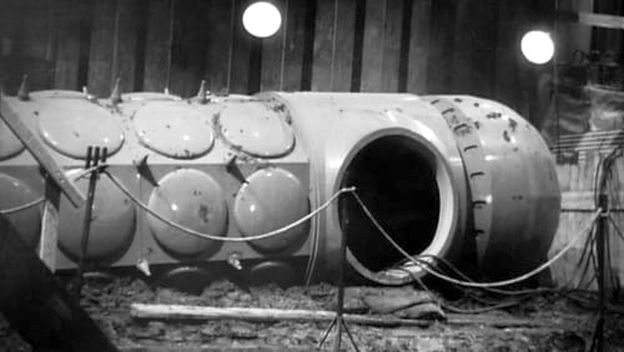
The alien spacecraft unearthed at the construction site in Hobbs Lane
Much to Quatermass's dismay, the British government has transformed the Rocket Group, which he had created for peaceful space exploration and research, into a military organization and assigns Colonel James Breen (Anthony Bushell) to oversee the excavation. The high-strung and strident Breen believes the spacecraft to be nothing more than an experimental German buzz bomb from WWII, the creatures from within nothing more than fakes. Needless to say, sparks fly between the two opposing personalities.

André Morell as Quatermass and Anthony Bushell as Breen play well off other, perhaps even better than Andrew Keir and Julian Glover in those same roles in the 1967 film — not that either of those actors are slouches; they are, in fact, quite imposing in their talents. Although I grew up knowing Keir as Quatermass (and in my adult years, I saw Brian Donlevy in the role in The Quatermass Xperiment [a.k.a. The Creeping Unknown, 1955] and Quatermass 2 [a.k.a. Enemy From Space, 1957], having now experienced Morell in the part, I can't help but consider him the "definitive" Quatermass. His mannerisms and appearance convey the character's typically stern demeanor while displaying a tad more wit and humor than either of the other actors. (I recently caught a portion of 2005's The Quatermass Experiment, featuring Jason Flemyng in the role, and I cannot say I was wholly impressed.)

Bushell's portrayal of Breen is anything but reserved. Initially, he appears a reasonable enough personality — stoic, tempered by military discipline — but as events spiral beyond his control, he becomes shrill and willfully blind to the mounting, irrefutable evidence regarding the aliens. Cec Linder (probably best known as Bond sidekick Felix Leiter in 1964's Goldfinger) as Dr. Roney acts brasher and more boyish than the taciturn James Donald as Roney in the Hammer film. While Linder plays a believable and likable character, he cannot rival Donald's striking screen presence. Still, he provides a fitting counter to Quatermass's grimmer personality. Christine Finn as Roney's assistant Barbara Judd, despite having several strong moments, such as when she volunteers to use the Optic-Encephalogram, never conveys the intense, haunted quality actress Barbara Shelley brings to the role in the Hammer film.

When an electrical accident jolts the spacecraft, all hell breaks loose in the city of London. Much of the city's population succumbs to a "hive mind" mentality and begin to attack, en masse, individuals who are not part of the hive. Quatermass calls this the "Wild Hunt," a recreation of an ancient Martian purge of all life forms different from themselves. London becomes an inferno as the Martian mastermind — "Hob," as it is known — asserts itself across the land. Roney and Quatermass determine that electricity fuels this phenomenon and devise a means of countering and ultimately defeating Hob, though at the cost of Roney's life.

Being so familiar with the 1967 film, it's virtually impossible not to compare the two productions. In both, events proceed in mostly identical order, both generally well-paced and developed. Despite its relatively low budget, the serial does provide some striking visuals, especially those involving the locust-like Martian creatures. I daresay their design is superior to the film's, with more realistic — and believable — detail. In both productions, the original Martian Wild Hunt as viewed through Roney's Optic Encephalogram features distorted video of the event, but the serial's imagery plays far better, as in the film, the Martians appear to be nothing more than rigid miniatures, crudely controlled by puppeteers.

The build-up to Hob's corporeal manifestation, increasingly charged with tension, may also be superior to the film's. Conversely, though not unexpectedly, due to budget constraints, there is only a brief, not altogether satisfying shot of the monstrous Hob rising from the remains of the spacecraft to hover above London. Similarly, in the film, Roney's sacrificial act to destroy the alien is spectacular and memorable. The serial's necessarily low-key resolution feels at once tragic and anticlimactic. I can only imagine the impact it might have had to viewers long before the film came to be.

Story-wise, Quatermass and the Pit is the quintessential blending of science fiction and horror. Both BBC serial and Hammer film easily hold coveted places at the pinnacle of alien invasion scenarios. Having now seen both, it feels like I've experienced the best of all worlds, for both productions shine in their respective milieus.

The domestic Blu-ray release of the Hammer film comes later this month, and I am eagerly awaiting the opportunity to view it again, this time with its predecessor fresh in mind. Together, in their own ways, these productions showcase Nigel Kneale's brilliant vision and screenwriting prowess as well as the vast talents of those involved in both serial and film.
Captain Potter (John Stratton), Colonel Breen (Anthony Bushell) and Quatermass (André Morell)
Barbara Judd (Christine Finn) and Dr. Roney (Cec Linder) with a reconstruction of a genetically altered primate
A manifestation of "Hob" towering over the city of London

Thursday, February 13, 2014

The Abominable Snowman of the Himalayas

It's review time! The current weather couldn't be more conducive to watching this venerable 1957 Hammer film, and last night, after a trying afternoon in the snow storm (see yesterday's entry, "The Great White Beast"), an eerie, late-night monster movie — though I use the term loosely — seemed just the ticket. I saw The Abominable Snowman of the Himalayas when I was a youngster, and I recall finding it boring. It was slow, talky, and featured little in the way of monster action. In my more mature years, I consider all of these things among the movie's major strengths.

Here there be spoilers.

The film begins with botanist John Rollasan (Peter Cushing); his wife, Helen (Maureen Connell); and his assistant, Peter "Foxy" Fox (Richard Wattis) undertaking an expedition to the Himalayas to uncover rare flora. Their base of operations is a remote Buddhist monastery overseen by an affable but rather enigmatic Lama (Arnold Marlé). Another expedition, consisting of adventurer Tom Friend (Forrest Tucker), trapper Ed Shelley (Robert Brown), photographer Andrew McNee (Michael Brill), and Sherpa guide Kusang (Wolfe Morris) arrives at the monastery, this one seeking the legendary Yeti — the Abominable Snowman of the title. Friend persuades Rollasan, over the objections of his wife, to accompany them on the long, dangerous climb into the mountains' upper regions.

Rollasan believes the Yeti might indeed exist but is interested only in the creature as a scientific marvel, while Friend seeks to capture one so he might make a personal fortune. On their ascent, the group discovers huge footprints in the snow that convince them the creature is real. Shelley sets out bear traps, but McNee ends up stumbling into one and is injured. That night, something visits their camp, sending Sherpa guide Kusang fleeing down the mountain. Shelley sees the silhouette of their mysterious visitor in the distance and shoots at it. Following the trail of blood, the men now learn that the Yeti is real, for Shelley has succeeded in killing one. Rollasan examines the body and claims it bears some resemblance to a human being, possessing a certain aspect of "wisdom." They wrap the gigantic body so that it can be transported by sledge upon their descent. However, strangely mentally affected, McNee takes off on his own and dies in a fall. Friend, determined to capture one of the creatures alive, has Shelley rig a net inside a cave and wait there with the dead creature's body for a visitation. The ploy succeeds in luring one in, but Shelley dies, apparently of fright.
Though their radio is broken, Rollasan hears a broadcast warning his party to leave the mountain. Convinced they cannot proceed farther, Friend agrees to abandon his search for a live creature and return with only the dead body as proof of the Yeti's existence. However, he then hears Shelley's voice calling "Help me!" from somewhere in the distance, and when he goes outside, he is killed by an avalanche. The Yeti themselves finally appear to Rollasan, the last remaining member of the party. In a silent but profound confrontation, Rollasan comes to understand the Yeti are indeed intelligent — and may, in fact, be simply biding their time until the end of humanity, when they will inherit the earth.

Helen Rollasan, concerned for the safety of the party, has mounted a rescue expedition, and they find her husband, nearly frozen to death in the snow. Upon their return to the monastery, now understanding the true nature of the Yeti, Rollasan tells the Lama they found nothing. Clearly understanding all, the Lama simply nods and states, "The Yeti do not exist."
The Abominable Snowman was directed by Val Guest (known for numerous Hammer films, including The Quatermass Xperiment, Quatermass 2, and When Dinosaurs Ruled the Earth, as well as contributing to 1967's Bond-ish extravaganza, Casino Royale), and written by Nigel Kneale, based on the earlier BBC-TV production, The Creature, which Kneale also wrote. The story is undeniably slow and oftentimes dialogue-heavy (Peter Cushing reputedly improvised many of his lines), but the film builds an eerie atmosphere, based on thoroughly convincing settings and on suggestive rather than graphic depictions of the Yeti themselves. Cuts between location shooting (in the Pyrenees range, one the border between France and Spain) and sound stage (Bray and Pinewood studios in England) are mostly seamless, creating an effective sense of visual continuity. The set for the Rong-Ruk monastery appears dark and claustrophobic, its interior maze-like, its inhabitants — portrayed largely by the staff from several London Chinese restaurants — quite convincing as Buddhist monks. A scene of a ritual ceremony, complete with masks representing the Yeti and foreign, almost alien chanting, agreeably calls to mind the Odo Island natives' ceremony in the original Godzilla, deepening the sense of strangeness that permeates this remote outpost of humanity.

Peter Cushing as Dr. John Rollasan exhibits his customary classiness as an actor. Playing a principled intellectual, he makes fine use of his distinctive voice and refined verbal mannerisms. As the sensitive but strong-willed professor, in his few scenes with Helen, he conveys a touching tenderness toward her, despite his character's intent to act against her wishes. Cushing's Rollasan is the necessary counter to Forrest Tucker's Tom Friend, a self-centered, reckless, yet not unlikable exploiter, whose doom is spelled early on by his abandonment of traditional morality. Robert Brown, who would succeed Bernard Lee as 'M' in the 007 movies of the late 1980s, plays the trapper, Shelley, with a shade too much exuberance, displaying the boisterousness and exaggerated physical gestures of a theatrically trained actor. The character McNee, portrayed by Michael Brill, is all but superfluous, offering little character depth or material contribution to the Friend expedition. His main role is to foreshadow the psychic influence of the Yeti prior to their actual onscreen manifestations.

Nerdy professor Fox, played with amusing British quirkiness by Richard Wattis, adds little substantive to the film; his sympathetic interactions with Helen Rollasan serve more to highlight her concern for and devotion to her husband. As Helen, Maureen Connell is afforded an opportunity to show a tad more backbone than many supporting female characters from this era of films, particularly those of the horror/science-fiction persuasion. Despite her inability to sway Rollasan from his danger-fraught intentions, she avoids that infuriating, helpless hand-wringing so typical of female characters of the day and takes an active role in bringing her husband back alive.

Humphrey Searle's musical score provides a dramatic backdrop for the film, sometimes low-key and atmospheric, other times brassy and powerful, effectively corresponding to the images on the screen. Other soundtrack cues — the keen howling of frigid wind; the disconcerting crying out of the voice of the dead trapper, Shelley; and the ominous warning coming over the clearly non-functioning radio set — work beautifully with the film's visuals to create a mood of unsettling loneliness, isolation, and soul-deep fear.

While undeniably slow-paced, with a sometimes long-winded script, The Abominable Snowman of the Himalayas presents a unique take on the Yeti legend and serves up some dark, foreboding atmosphere reminiscent of Universal's Creature From the Black Lagoon with Hammer's distinctly British bent. It's easy to understand why, as a child, I found the film boring; it doesn't conform to childish expectations. It seldom appears on broadcast television anymore, and though it was released on DVD by Anchor Bay over a decade ago, it is no longer readily available. I have an excellent VHS copy that I recorded from AMC back in the dark ages, when it broadcast movies uncut, without commercials, and featured hosts who provided commentaries before and after each film. I imagine I will have to settle for that version for the foreseeable future.

If you get the chance to view The Abominable Snowman, I would strongly encourage you not to miss it.