I love movies and fiction about scary things in the woods, probably because I
grew up around woods, and when I was a kid, the sounds that came out of them at
night scared the crap out of me. I attended several summer camps, and horror
stories about the surrounding woods abounded. I watched countless movies about
Bigfoot, kith and kin, such as
The Legend of Boggy Creek,
The Creature From Black Lake, The Legend of Bigfoot, et. al. — in fact, I've recently been on one of my periodic Bigfoot movie
binges, watching everything from the best to the worst of them.
When
The Blair Witch Project came out in 1999, I was hoping for
something as chilling as the hype portended. To be sure, the movie had a lot
going for it, at least in concept, and it laid the groundwork for a long line of
shaky-cam-found-footage successors (I don't think I can offer any thanks for
that). But the dopey characters and nauseating cinematography just about ruined
the experience for me, despite some genuinely chilling moments, such as the
discovery of sinister stick figures (which appeared to have taken their
inspiration from Karl Edward Wagner's brilliant short tale, "Sticks"), and the
strange, unidentifiable night sounds around the characters' campsite. The
sequel,
Book of Shadows: Blair Witch 2, at least did something altogether different with the premise. Different, of
course, doesn't mean inspired, and at best,
Book of Shadows is a
moderately enjoyable, rather standard horror flick.
Here there will be spoilers.
Perhaps the most successful treatment of the Blair Witch property is 1999's
Curse of the Blair Witch, a 45-minute, made-for-television faux documentary that expanded on the
backstory of both the Blair Witch and the three lead characters, to more
satisfying effect than the actual movie. This short film illustrated in detail
how well-conceived the Blair Witch legend actually is, and also — no doubt
contrary to its original intent — highlighted how the first movie (and by
default, the second) fell short of so much promise. A couple of other
"mockumentaries,"
Sticks and Stones: An Exploration of the Blair Witch Legend
(1999) and
The Massacre of The Burkittsville 7: The Blair Witch Legacy
(2000), further elaborated on the Blair Witch backstory. Taken together, these
mockumentaries create an appealing sense of authenticity about the Blair Witch
mythos.
Having enjoyed steeping myself in Blair Witch lore over the years, despite not
caring so much for the original film, I couldn't
not check out the most
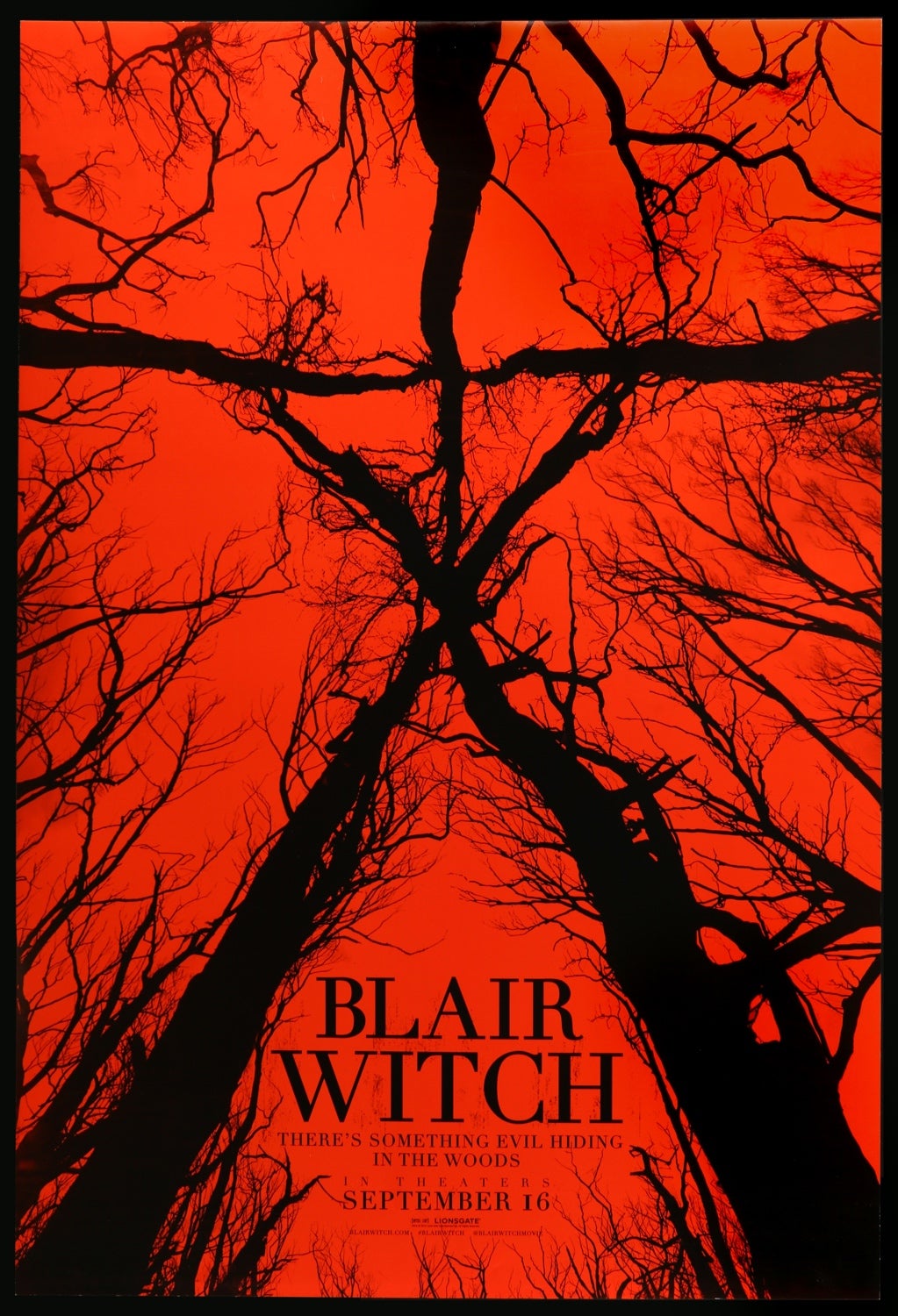
recent entry in the series, titled simply
Blair Witch, (known as
The Woods prior to its release, as a means to keep
its connection to the franchise a secret). This one takes place seventeen years
after the original — which, if the film is actually set in present rather than
2011, would create some incongruity, as the events of the original ostensibly
occurred in 1994. The story centers on James Donahue (James Allen McCune),
brother of Heather Donahue from the first film, and three cohorts, Lisa
Arlington (Callie Hernandez), Peter Jones (Brandon Scott), and Ashley Bennett
(Corbin Reid), who set out for the woods around Burkittsville, MD, on a quest to
find the long-missing Heather, who James believes may still be alive after some
footage in which she appears is posted online. They are accompanied by Lane (Wes
Robinson) and Talia (Valorie Curry), who posted the footage, which they claim to
have found in an area of the woods where the original
Blair Witch Project kids disappeared
In the woods, the group sets up camp and prepares to spend the night. Now,
unlike Heather's crew, James and friends have come prepared to face the
outdoors, with GPS units, cameras of all sorts, a camera-equipped drone, and
plenty of flashlights. Once settled in their tents, they go to sleep but are
awakened in the middle of the night by strange rustling sounds and voices in the
woods. When they get up the next day, they discover that it is two o'clock in
the afternoon and the strange stick figures, like those that appeared in the
first movie, have been strung all around the campsite. Lisa notices that Lane is
carrying some twine that exactly matches the twine used to bind the stick
figures, and also that his old video camera uses the exact same kind of tape
that he supposedly found in the woods. After some pressuring, he admits that he
and Talia created the stick figures to scare them off, but only because they
genuinely believe the Blair Witch exists in the cursed woods. Angered to the
point of violence, James, Lisa, Peter, and Ashley run Lane and Talia off,
ordering them to stay away from them.

|
|
Heading out into the woods, Lisa (Callie Hernandez) takes a last,
worried look back at the "normal" world.
|

|
|
Scary stick figures that have mysteriously appeared around the campsite
during the night
|
James and his party hike for the rest of the afternoon but — in a too-eerie
repeat of events from the first movie — they find, even after following their
GPS, they have gone in a circle and ended up back at their campsite. Lisa sends
up the drone to get an aerial view of the forest, and she is stunned to find
that the road, which they had previously been able to see, is no longer visible
from above. Then the radio controls freeze, and the drone falls from the sky to
crash somewhere in the woods. The group is forced to spend another night at
their original campsite.

|
Talia (Valorie Curry) stumbles back into camp, after having
been trapped in perpetual night for five days.
|
Peter, while searching for wood to keep the fire going, encounters
something that attacks him, and he disappears. Meanwhile, Lane and Talia
reappear, haggard and exhausted, claiming that they have been wandering for five
days — but in perpetual night. Sure enough, sometime later, though their watches
tell them it's morning, no sun appears. And once again, they discover the
campsite surrounded by stick figures. One of them appears to be bound with
Talia's hair, and when Lisa snaps the figure in half, Talia's back breaks and
she dies. Lane disappears in the darkness, and James, Lisa, and Ashley become
separated from each other. While wandering hopelessly, Ashley sees the lights of
the drone, stuck in a tree high overhead. Desperate to retrieve it, she climbs
up the tree, but just as she reaches the drone,
something impacts her,
and she falls to her death.
James and Lisa meet up again, but now they come upon the old Rustin Parr house,
where, in 1940, seven children were abducted and murdered. James believes he
sees his sister in a window, and he goes inside after her. Lisa follows him in,
but here, she encounters an aged and wild-looking Lane, who attacks her. She
manages to stab and kill him, but now a bizarre, distorted-looking figure,
barely visible in the darkness, comes after her. With Lane's camcorder, she runs
up the stairs to the attic (creating the footage that Lane originally posted
online), where she once again meets James.
He tells her to face the corner and not look around, believing that the witch
will only kill them if they look directly at it. However, he hears Heather's
voice speaking to him, and he turns around, only to be whisked away in the
darkness. Then, Lisa hears him apologizing to her, and she turns around....

|
|
To escape from the Rustin Parr house, Lisa is forced to crawl through a
dank underground tunnel.
|
#
Critically,
Blair Witch was far from a howling success, with most
reviewers and audiences calling it a more polished but beat-by-beat retread of
the original film. To some extent, this is true — my first impression was that
it was basically the
The Blair Witch Project on steroids. Indeed,
it's louder, annoyingly frenetic, and full of unnecessary jump scares in place
of genuine suspense. Yet it also delivers more substance, particularly toward
the end, than it's usually given credit for. While the characters may not be
likable geniuses, they come across as relatively sensible and, as characters go,
far more palatable than the three dolts in the original. It may be James's
repeated insistence that his sister Heather could still be alive in the woods
after seventeen years that most stretches his credibility, particularly since
the video that inspires his quest reveals only a vague glimpse of the female in
question.
There are several central aspects of the Blair Witch mythos introduced in the
original movie, explored in the mockumentaries, and expanded upon to varying
degrees in this film. To summarize, the Blair Witch was a woman named Elly
Kedward, who lived in the village of Blair, Maryland, in the late 18th century.
She was accused and convicted of witchcraft, taken into the woods, hoisted into
a tree with heavy rocks hung from her arms and legs, and left to die. Shortly
afterward, all her accusers as well as half the town's children vanished, and
the rest of the town's inhabitants fled, fearing a witch's curse. Later, the
(real) town of Burkittsville was built on the site of the old village.
Other noteworthy events followed. In the early 19th century, a child drowned in
a shallow stream in the woods, after witnesses said an arm reached up from the
water and pulled the kid under. In 1886, another child was reported missing and
a search party went into the woods, never to return. The child returned
unharmed, but another search party was sent out in search of the first. This
group found the remains of the first search party at a location called Coffin
Rock, the bodies tied together, all disemboweled. Then, in 1940, a hermit named
Rustin Parr, who lived in the woods outside of Burkittsville, abducted eight
children and took them to his house, where he had one child stand in a corner
while he murdered and mutilated the others. He was arrested and confessed to the
killings, saying he had been incited to murder by a disembodied voice, which
might have been the Blair Witch. After being convicted, he was hanged,
and the townspeople burned his house to the ground.
Yet — it is clear in the films that the house in the woods
is, in fact,
Rustin Parr's house, though we know it was burned decades earlier. In
Curse of the Blair Witch, we learn that the videos made by Heather, Josh, and Mike in the first film
were discovered by archaeology students in the ruins of an old structure —
presumably one of the original buildings from the old town of Blair — under
rocks and earth that had not been disturbed since the 18th century. Furthermore,
in both movies, the groups end up hiking in circles, unable to escape the woods.
In
Blair Witch, we have several days of night passing for one group, while for the other,
only a single night goes by. And the most novel paradox may be the fact that the
footage which drew James and his party to the woods is actually filmed
by Lisa in the Parr house.
So, indeed, the Blair Witch curse involves an altering of time and space. In the
first movie, this premise is merely suggested, while in the 2016
Blair Witch,
it's spelled out in huge neon letters. I read an interesting
suggestion that the strange noises in the woods at night are actually the sounds
of space reshaping itself to prevent the characters escaping. It's the curse's
shifting of dimensions that I find most fascinating about the franchise,
hearkening back to concepts in H. P. Lovecraft's "Dreams in the Witch House" and
others. Years back, when discussions about
The Blair Witch Project were in vogue, plenty of viewers argued
the kids were simply too dense to find their way out of the woods and there was
no supernatural influence at work. That argument simply doesn't hold up,
however, for — as the characters even stated in the film — in that area of
Maryland, simply by way of the geography, they
would have emerged from
the woods, and devoting half the film's running time to highlighting their
ineptitude hardly squares with the movie's theme. In the new
Blair Witch, the supernatural transformations of time and space render the countering
hypothesis moot.
For bringing on a rush of sheer visceral dread, it would be difficult to top the
scene of Lisa making a harrowing escape from the Parr house by way of a narrow,
underground tunnel, choked with tree roots and half-filled with water. At one
point, she gets stuck in the passage, and since I have crawled through a
subterranean passage called "The Birth Canal" at Worley's Cave in Tennessee, not
to mention innumerable underground culverts after geocaches, I found myself
holding my breath during this scene. For any viewers suffering from
claustrophobia, I can see it hitting a sensitive nerve.
For the first time, we get a glimpse of what we must assume is the Blair Witch
herself. While the characters are trapped inside the Parr house, in a couple of
quick, almost subliminal shots, a tall, spindly figure can be seen moving in the
shadows, presumably reinforcing the idea that Elly Kedward's arms and legs had
been stretched as if on a rack by the heavy rocks tied to them. The shots are
effective since they are so quick and vague.
Blair Witch's most serious shortcomings — the obvious intention to "out-scream" the
original, the myriad pointless jump scares, and a structure too closely matching
its predecessor's — are not trivial, and they only diminish the positive impact
of its better elements. But I do believe that a lot of viewers, overwhelmed by
the frantic pace, the oftentimes too-jerky camerawork, and the shrill squalling
of young people in terror, may be missing or underestimating the strength of the
underlying story. Beneath all the rick-rack and racket, there are some genuinely
frightening, even Lovecraftian concepts at work here. On that count, I heartily
approve.
While
Blair Witch respects its source material and expands on
concepts introduced in the original, it doesn't break any new ground or set any
new film-making trends in motion, which — whether you approve or don't —
The Blair Witch Project certainly did. It's a mixed bag: effective
enough to admire yet dopey enough to disappoint. If you enjoyed the original
movie, you may well enjoy this one. If you didn't, you'll hate this one, maybe
more than the first. I'll give it a thumbs-up but with some eye rolls.
Three out of five
Damned Rodan's Dirty Firetinis.

|
Peter (Brandon Scott), Ashley (Corbin Reid), James (James Allen McCune),
Talia (Valorie Curry),
and Lane (Wes Robinson)
|