Friday, August 28, 2015

The Reason We've Never Gone Back to the Moon...

Since its release in 2011, I've read very little positive about Apollo 18, another found-footage science fiction/horror thriller à la The Blair Witch Project, Cloverfield, et. al., but its premise struck me as appealing enough, so I figured I'd eventually give it a look. This evening, eventually came to be, and, while the film is no masterpiece, I am inclined to be a little kinder to it than most reviewers. If the title isn't enough to give it away, it's about an "undocumented" Apollo moon mission following the last official moon shot (Apollo 17 in 1972). The movie is cobbled together from videos ostensibly shot by the crew on its ill-fated mission, and while I tend to look down my nose (way the hell down my nose, as a matter of fact) at endless, dizzying shaky-cam footage, there are enough steady shots and suggestive, weird images to make the visual experience generally palatable.

There be spoilers ahead.

Three astronauts — Mission Commander Nate Walker (Lloyd Owen), Captain Ben Anderson (Warren Christie), and Lieutenant Colonel John Grey (Ryan Robbins) — are sent to the moon on a top-secret mission to place DEW (Distant Early Warning) devices on the lunar surface to detect possible attacks from space by the Soviet Union. Once the Apollo spacecraft, named Freedom, achieves lunar orbit, astronauts Walker and Anderson descend to the surface in the Lunar Excursion Module Liberty, while astronaut Grey remains in orbit aboard the command module. Walker and Anderson venture outside their spacecraft, plant the American flag, place their sensors, and collect some lunar rock samples. During their subsequent communications with Earth, they hear strange sounds over the radio, which they believe to be interference from the transmitters they have placed. Then they find one of their rock samples, which had been stowed away, on the floor of the cabin. On their next outing, in their lunar rover, Walker and Anderson discover human footprints — which lead them to the remains of cosmonaut and a Russian lunar lander. They report their discovery to Mission Control, which orders them to continue their mission as planned.

The next day, the astronauts wake to find their flag missing. Realizing something is terribly wrong, they begin preparation to take off and return to space to rendezvous with the Freedom, but something violently assaults the landing craft and damages it so they can't take off. Outside, they discover the tracks of some non-human entity — and Walker suffers an attack by a spider-like creature inside his spacesuit. Anderson rescues him, but Walker is now infected by an unknown organism that spreads through his system, making him paranoid and irrational. In a violent rage, he smashes the onboard oxygen system. Hoping to find an oxygen supply aboard the Russian lander, they set out in the rover, but Walker again becomes violent and wrecks the vehicle. Anderson realizes the arthropod-like aliens camouflage themselves as rocks, and he is surrounded by them. He manages to reach the Russian lander, but Walker again attacks and attempts to smash the lander's window with a hammer. This time, though, the alien creatures swarm over him and kill him, allowing Anderson to take off and go into orbit.

Unfortuately, as he soon discovers, the lander is filled with lunar rocks....

Before the launch: astronauts Anderson (Warren Christie), Grey (Ryan Robbins), and Walker (Lloyd Owen)
Lunar rover and astronaut on the surface of the moon
The film necessarily focuses on the three astronauts, with Anderson as the primary protagonist. The actors do a capable enough job, and as their faces are not necessarily familiar to the public at large, they convey a sense of verisimilitude that more recognizable actors probably would not. They look and act more or less as one might expect real astronauts to look and act, and Anderson in particular comes off as a sympathetic character. With a blend of actual footage from lunar missions and well-crafted sets — from the claustrophobic spacecraft interiors to panoramic expanses of lunar surface — there is a genuine sense of remote isolation. While the sets and scenery come off as quite realistic, inside the lander, the characters move and operate as if in normal earth gravity, belying the actual location filming; on occasion, however, the use of odd camera angles and quick cutting helps insinuate the effect of reduced gravity.

To get around the absence of sound in a vacuum — without resorting to the totally unrealistic trope of outer space being an ultimately noisy place — the soundtrack often provides low, surreal thumping, bumping, whooshing sounds, simulating the kind of noises the astronauts might hear within the confines of their spacesuits while operating in a void. In addition, the alien noises that emanate from the radio set have an organic, insect-like quality that early on betray the fact that there's something happening beyond mere electronic interference.

The creatures themselves appear mostly as strangely deformed rocks that move. Quick cuts and mere suggestions of something moving at the edge of one's perception work to build a bit of suspense. Eventually, once the creatures appear in earnest, they're still a bit vague — obviously crab- or spider-like, but the camera's eye never quite gives you the full picture. Not a bad way to present them, all in all. There's never any explanation or even supposition of what these things are, which, within the scope of the story, is the way to go. Unfortunately, it's revealed that the government has sent the astronauts up as human guinea pigs, on a mission not unlike the Nostromo's in Alien. It's a tired device, and I suspect the story might have worked better if the mission had been all about detecting Soviet missiles, with the creatures being discovered in the process, instead of the mission being a secret attempt to gain superiority over the Russians by way of capturing and controlling dangerous alien life forms.

One of the criticisms I'd seen that I quite agree with is that, though the film runs less than 90 minutes, it seems much longer. Yes, it does. While much of the drama is effective and the sensory effects produce the desired results, the varying camera angles, the dizzying transitions, the indistinct images, and confusing cuts also tend to produce fatigue. I recently reviewed Troll Hunter, which includes found footage, but it also provides a much smoother viewing experience, with less chaotic camera work, making for a less fatiguing and more appealing movie. If Apollo 18 had gone that route, I expect it would have been better received.

Nope, it's not all that it ought to have been, but Apollo 18 does offer more, drama- and production-wise, than it gets credit for. I'd give it a solid three out of five Damned Rodan's Dirty Firetinis.
The remains of a Russian cosmonaut, whose mysterious fate soon becomes all too clear
The Russian lunar lander, whose spider-like contours provide an appealing visual irony
There's something inside Astronaut's Walker's space helmet....
An interesting — moving — rock formation, wot?

Sunday, August 23, 2015

Community Dead Zones, Iron Furnaces, and Others

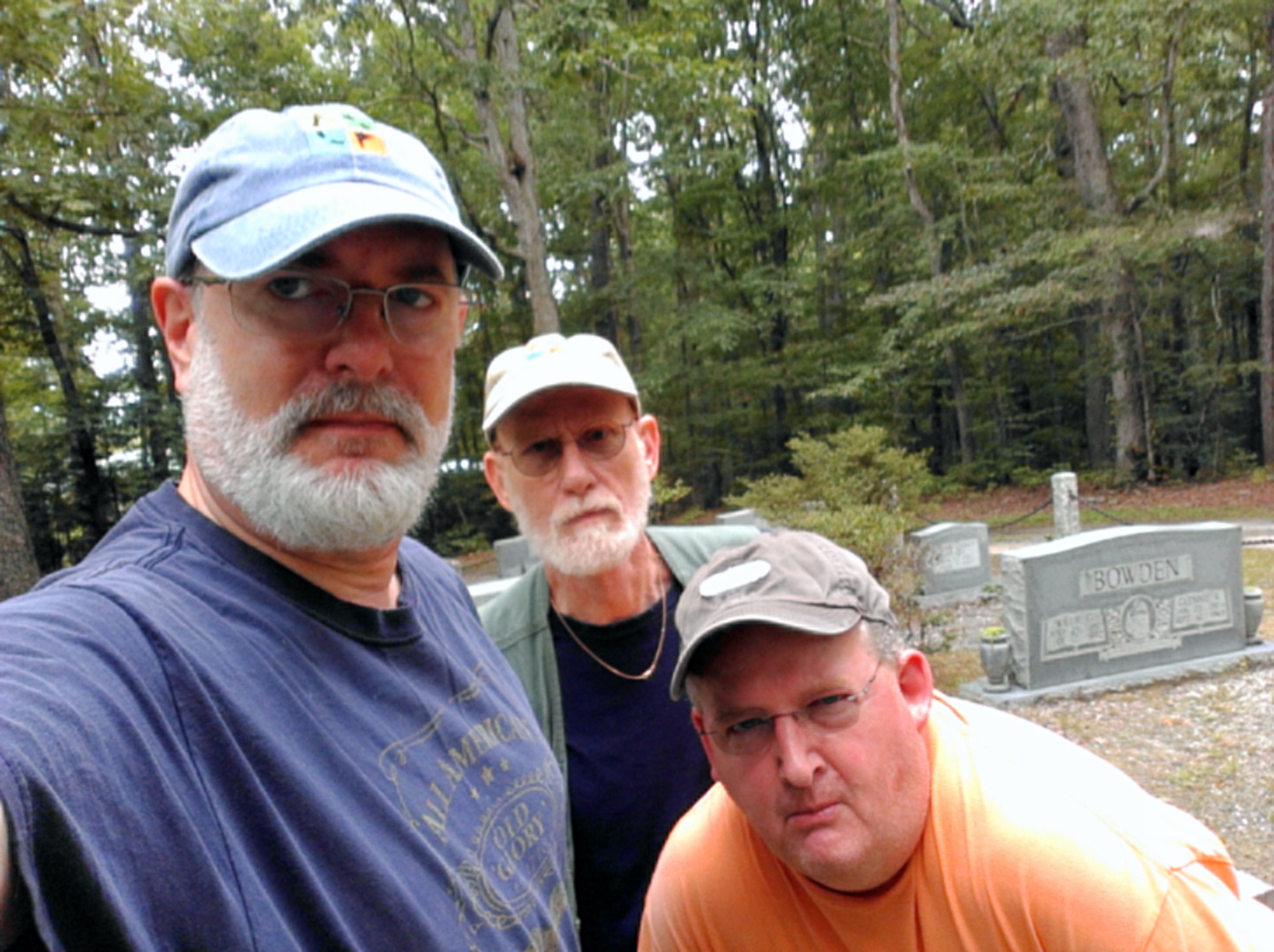
Old Rodan and a pair of Rob zombies
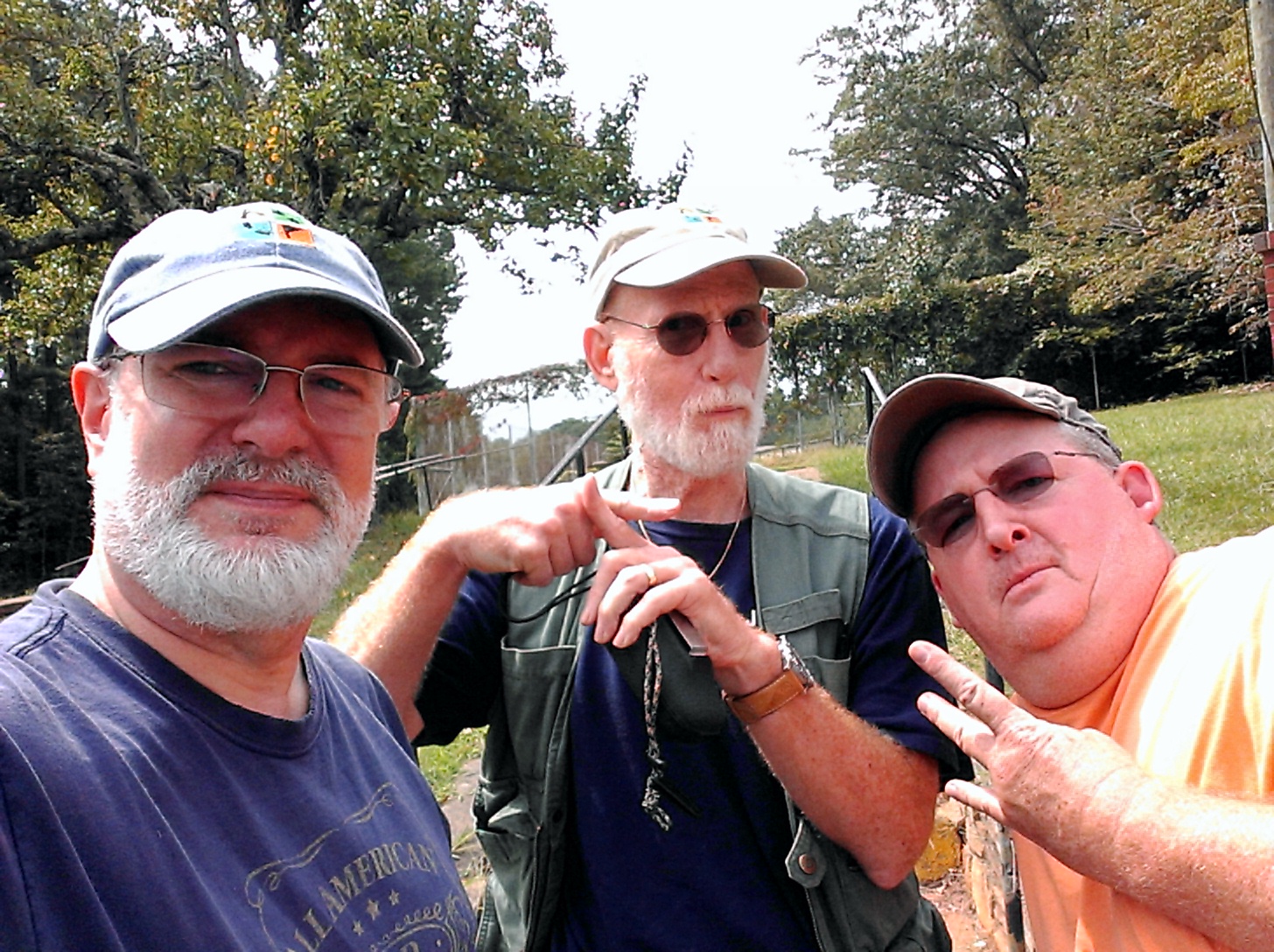
This morning, the original Team Old Fart — Old Rodan, Robbin (a.k.a. Yoda Rob), and Robert (a.k.a. Old Rob, Bloody Rob, Robgso, et. al.) — headed out into the wilds of Stokes County for a day of geocaching in some of North Carolina's most scenic rural surroundings. We picked up a modest ten caches, but today, quality exceeded quantity by a long shot. We experienced lonely, shadow-laden graveyards; the remains of a 19th-century iron furnace; a hidden walkway beneath an old stone bridge, featuring a cache aptly called "Welcome to Jurassic Park" (GC61H34); the ruins of an abandoned prison farm; and the village of Danbury, which is rich in Civil War history, raided by Union General George Stoneman in March of 1865.

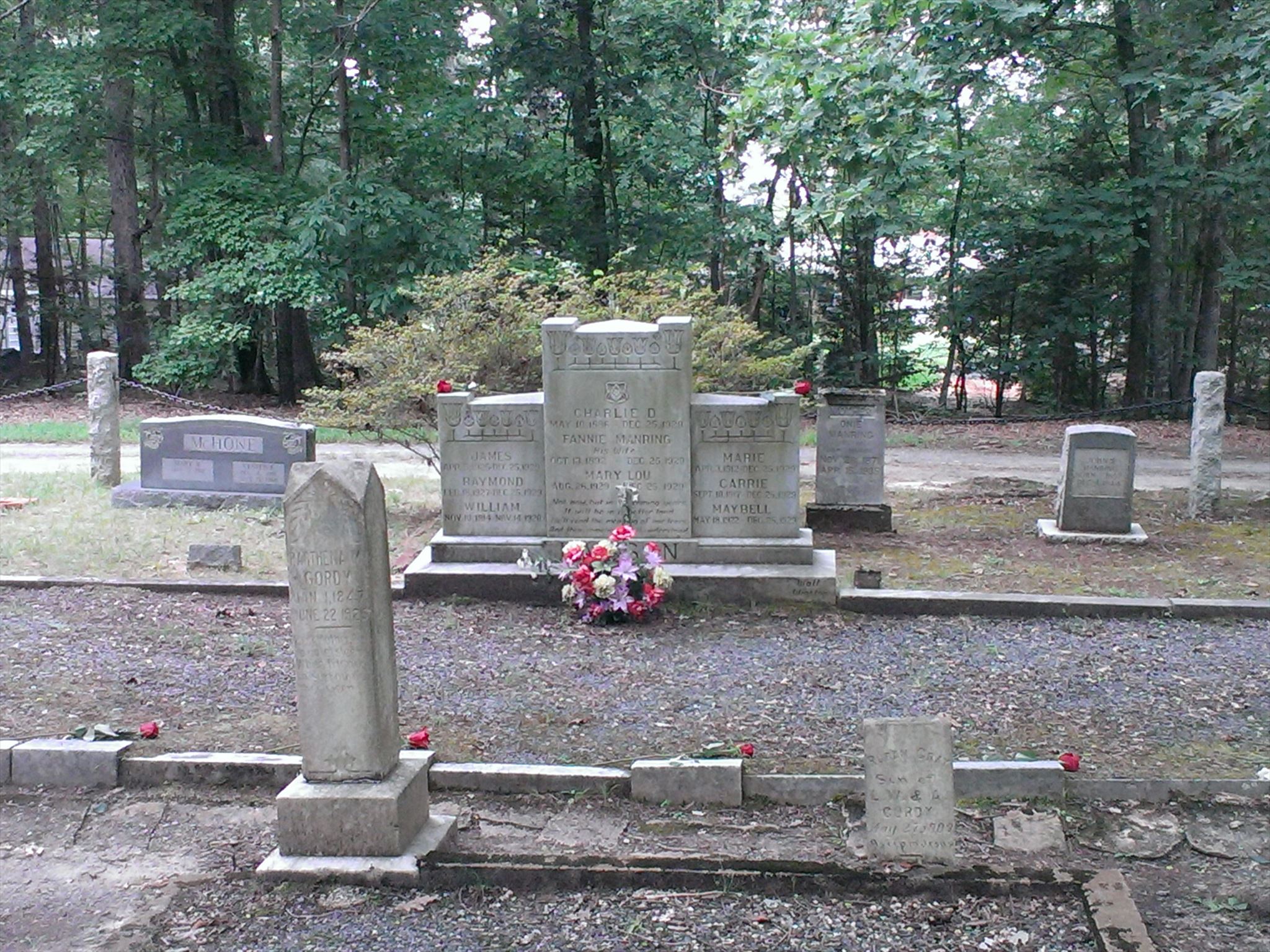
"Community Dead Zone #1" (GC2YCZC): a picturesque little graveyard tucked away from civilization — such as it is, out here in the sticks — where you will find the graves of mass murderer Charlie D. Lawson and his wife and children, whom he shot dead in the year 1929. The story is thus (excerpted from Wikipedia):

"Charles Davis Lawson (May 10, 1886–December 25, 1929) was a Stokes County tobacco farmer who is remembered for having committed one of the most notorious mass murders in the state's history. On Christmas Day, 1929, Lawson killed his 37-year-old wife, Fannie, and their children Marie, 17; Carrie, 12; Maybell; 7, James, 4; Raymond, 2; and Mary Lou, 4 months.

"Lawson began the slaughter with his daughters, Carrie and Maybell, as they were setting out to visit their uncle and aunt. Lawson waited for them with his shotgun behind the tobacco barn, and when they were in range, he shot them. He then placed their bodies in the tobacco barn.

"Next, he returned to the house and shot Fannie, who was sitting on the porch. Inside the house, Marie, upon hearing the gunshot, screamed in terror, while the two small boys, James and Raymond, attempted to find a hiding place. Lawson entered the house, shot Marie, and then found and shot the two boys. Lastly, he killed the baby, Mary Lou. After the murders, he went into the nearby woods, where he finally shot himself. The only survivor was his eldest son, 19 year-old Arthur, who had gone out on an errand.

"Many people had learned of the gruesome event and gathered on the property when the gunshot signaling Lawson's suicide rang out. The bodies of the family members were found with their arms crossed and rocks under their heads. The police officer who found Lawson's body also discovered several letters to his parents, which he had written prior to his killing spree.”

The serene beauty of this old graveyard provided a most inviting contrast to the macabre story of the Lawson murders. While hunting the cache, which is just outside the boundary of the graveyard, I was standing at a spot that, according to my GPS, was one foot from the cache, looking down. Yoda Rob suddenly hollered, "It's there!" and pointed to where I was standing. When I looked up, the cache container smacked me right in the face. How handy — better, I suppose, than encountering a ghost with a ghostly shotgun.
The Lawson family graves
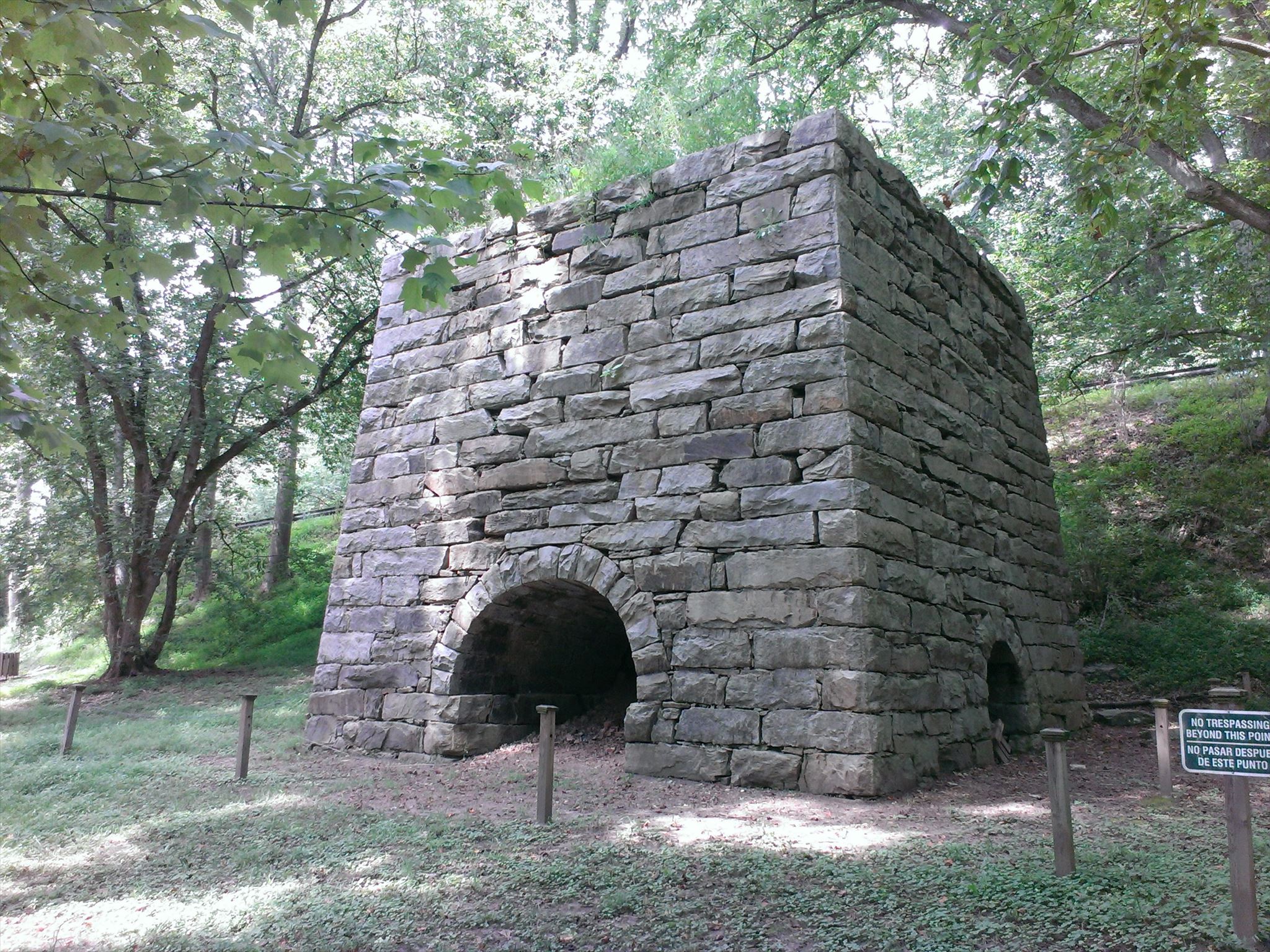
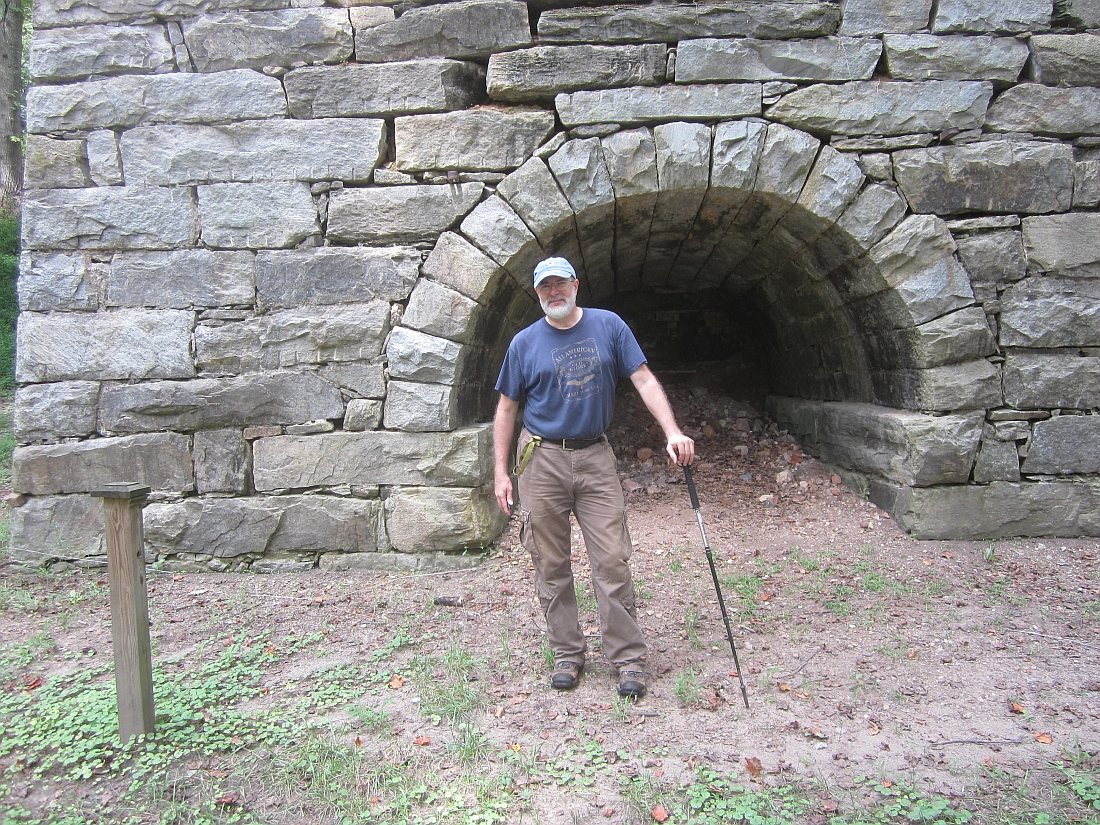
Not far away, we find Moratock Iron Furnace, which was built by Nathaniel Moody and John Pepper in 1843. During the Civil War, iron from the furnace was used to make swords and munitions for the Confederacy, which was cut off from outside sources of iron. In April 1865, Union General George Stoneman destroyed the furnace’s outbuildings, though they were eventually restored to operating condition, and the furnace continued to operate until the 1890s. The Moratock furnace is one of only a handful of iron furnaces that remain intact in North Carolina. There are two nice multi-caches to be found in Moratock park. No ghosts here; just a pair of Rob zombies, who would not stop following me.

Historic Danbury is a small village at the edge of the mountains in Stokes County, with many restored 19th century buildings still in use today. When General Stoneman raided Danbury in 1865, he set up his headquarters in Moody's Tavern in the center of town. Though the building remains in near-pristine condition, the tavern itself has long since closed; I suspect that if restored, it would do a brisk business. We hoofed it from one end of town to the other, gathering clues to the location of the final cache. Once again, we discovered a scenic, historical graveyard that brought much joy to this geocaching writer of all things horrific.

However, rather sadly for me, this trip cleared out all the caches I had yet to find in and around Danbury. I'd love it if some fine geocacher whose sphere of influence includes this community would populate the area with a few more nice hides so the Old Farts might ride again out that way. Hope shambles eternal.
Moratock Iron Furnace
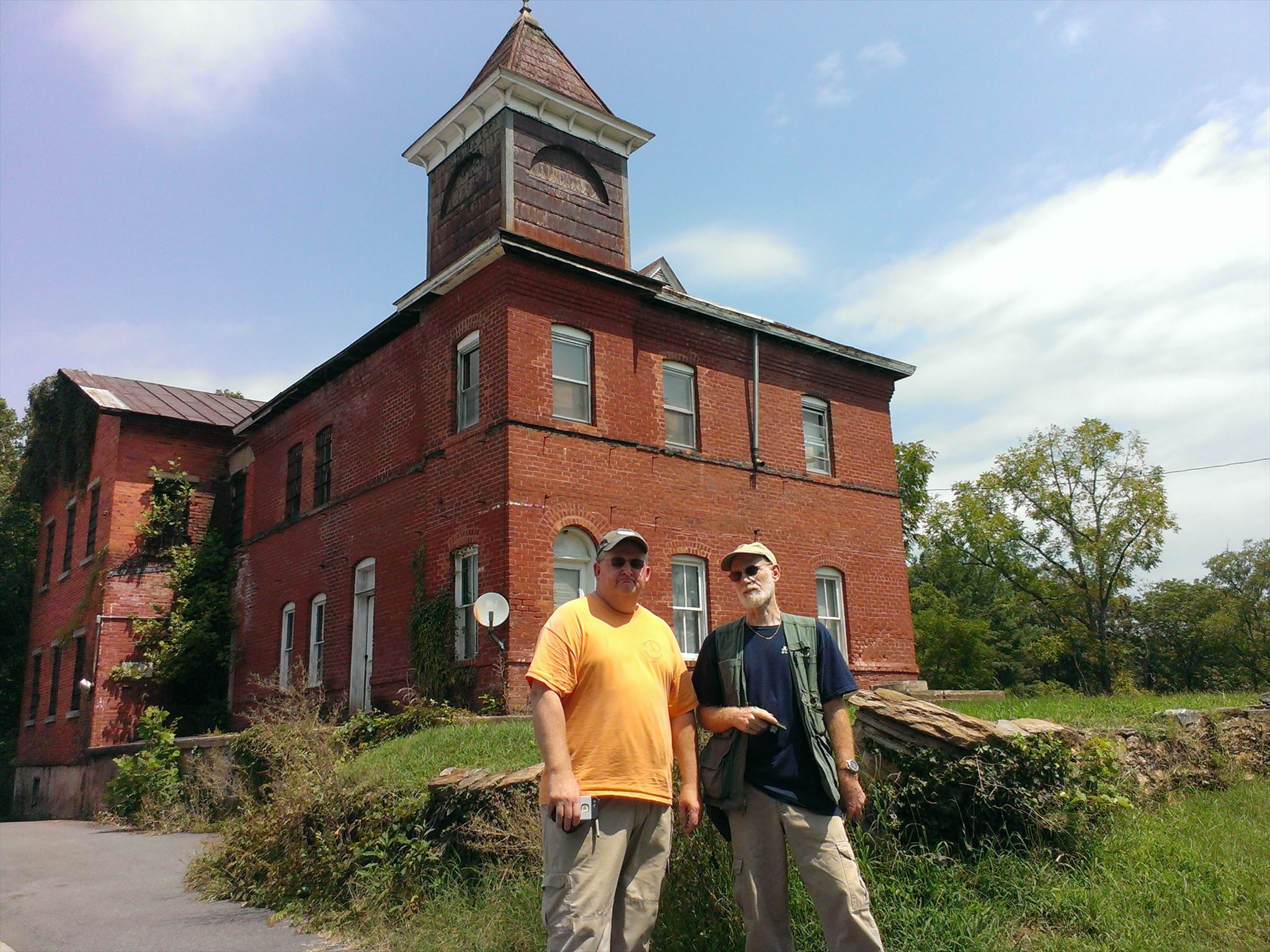
Yoda Rob and Bloody Rob, inmates at the old prison
The zombies followed me, they did.
Stokes County courthouse in Danbury
Ol' Rodan beating the heat at Moratock Iron Furnace

Tuesday, August 18, 2015

August Book Festival at Brewed Awakening

Binding Time Café & Bookstore in Martinsville, VA, has moved to Danville, VA, and changed its name to Brewed Awakening — in fact, the new location just opened for business this week. For the past several years, as some of you will recall, Binding Time has put on a regular book festival featuring numerous local authors, including the old dude, and Brewed Awakening will be continuing the tradition. The next festival will be held on Saturday, August 29, from 10 AM till 2 PM, and I'll be on location to sell and sign books (yes, my own; I get fussed at for signing other writers' books). I plan to have copies of The Monarchs, Blue Devil Island, Other Gods, The Gaki, and possibly others on hand, so if you are in traveling distance and possessed of exceptional intestinal fortitude, by all means, stop by. I'd love to see you.

Not only does Brewed Awakening sell books, they serve first-class sandwiches, wraps, and beverages (I'm especially fond of their hazelnut latte). And for you intrepid souls who enjoy geocaching as much as braving Rainey's horrifying books, Danville is a geocaching mecca — in fact, there is a cache ("The Crossing," GC1BR2C) directly across the street from the café. Good books, good refreshments, good geocaching. A regular hat trick, wot?

Mark your calendar and join us.

Brewed Awakening Book Festival 
Saturday, August 29, 10 AM–2 PM
610 Craghead St., Danville, VA 24541
(434) 483-2138


Tuesday, August 11, 2015

Pirates of the Seven Lakes

For me, the best part of geocaching is getting out on woodland trails; discovering the deepest, darkest, most hidden corners of even the most familiar territory; working out the muscles and refreshing the mind. When I started caching in early 2008, I found that, within just a few miles of home, more trails existed than I could have ever dreamed. Miles and miles and miles of them. In those early days, I hiked almost every day, more fired up about exploring the woods than since I was a wee young 'un, when I was a regular woodland troll (a mischievous one too, I'll have you know). In Greensboro proper, there are thousands of caches, a good percentage of which reside on the trails, and since 2008, I've claimed virtually all of them — with a couple of exceptions.

"Pirates of the Seven Lakes" (GCJ37H) is one of the most notable. It's been out there since long before I started caching (it was placed in 2004, as a matter of fact), and after all these years, I've finally scrawled my moniker on the logsheet in that big ol' ammo can in the woods. In its original incarnation, "Pirates" was a multicache with at least nine separate stages, which included puzzles, brain twisters, and all sorts of logistical nightmares to challenge the hardiest geocacher. It was spread out over many miles and many trails, requiring some ten miles of hiking and visiting trails at each of Greensboro's watershed areas. One stage included a DVD, which you either had to watch on a portable player in the field or take home so you could solve the video puzzle to get the coordinates for the next stage. All these challenges resulted in "Pirates" being rated 5 for overall difficulty and 5 for the terrain challenge — the most difficult ratings possible for a cache. Alas, some years back, the original cache owner moved away or retired from the activity, leaving the stages to languish out in the woods. Some went missing, some were destroyed, and during the past few years, a scant handful of cachers have searched for it, and most of those who found it did so by receiving help from previous finders so they could get past the stages that were no longer viable.
One of the clue puzzles to solve along the way — quite useless out of context.
All this has changed, thanks to my old — and I do mean old — caching buddy Robgso (a.k.a. Robert, the Old Trail Dawg, or sometimes Bloody Rob), who has adopted and restored the cache to functional status.

Over the years, I had tentatively arranged to head out after "Pirates" with one group or another, but, for whatever reason, no solid plans ever came together. On at least two or three occasions, I had given the first stage a fair look, yet I just couldn't spy the bloody thing — despite knowing, both from the hint on the cache page and from anecdotal evidence, that I was searching the correct location. Ah, the frustration! When it came to my attention that several of the stages lay in disrepair, for the longest time I ended up just ignoring the cache altogether. However, in recent days, ye old Trail Dawg divulged to me that, because this cache is such an old classic, he was committed to fixing the wayward waypoints rather than archiving the whole sheboygan. At last, I figured, I would be able to take my shot at it. Sure enough, last week, Bloody Rob placed a cache in the woods on his birthday (which he does every year), and my outing to claim it took me to the Nat Greene Trail up at Lake Brandt. So — just on a whim — I gave stage 1 of "Pirates" another look. And this time — holy freaking banana oil — there was the container, plain as day, right where it's always been, in excellent condition. So, on the spot, I decided I'd start working on this cache — but over more than a single trip because I prefer to maximize my opportunities for hiking, what with so few local trail hides to go after anymore. For the past few days, I've picked up a stage or two, steadily working my way toward acquiring the final coordinates. At last... done. And this afternoon, I headed out to the trail head, made the near two-mile hike to the final, and, after a relatively brief search, found that great big ol' ammo can. But Sweet Freaking Yuggoth, the humidity! Old Rodan was one sweaty, melty, drippy mess while signing the log. But... by what ethereal dances, by what eternal streams... "Pirates of the Seven Lakes" was at long last conquered.
Buddha tree along the greenway,
near Owl's Roost

Now, to be fair, what was once a near-unthinkable monster in the woods is now more a straightforward multi, with only a couple of field puzzles — perfect for the more simple-minded among us to conquer. While I've no doubt the original experience was a masterpiece of geocaching engineering, this incarnation represents everything I love about caching: getting away from my damn computer (I'm on one most of the waking hours of my life) and out into the woods, exercising my muscles as much as or more than my brain, and stalking that elusive goal until I have conquered the rotten old bastard with the cheapest of ink pens. This one may no longer be a true 5/5, but it is a 5x favorite for this old caching dude. This one is la bombe surprise.

Curiously, while I was unaware of it at the time, several years ago — 2008 or 2009 — I had actually had a run-in with a stage of "Pirates." I was out on the Laurel Bluff Trail, searching for an appealing location to hide a cache of my own, and after much exploration of the woods, I found what I considered a perfect spot — only to a discover, rather to my chagrin, there was already a cache container in that spot. Since it wasn't listed anywhere on the geocaching.com site, I knew it had to be a hidden stage for some multi or puzzle cache, but I had no way of determining which one it was, for the container was empty and unlabeled. The other day, as I was following my GPS to the coordinates to stage 4 on the Laurel Bluff Trail, I knew immediately where I was going to be heading: yes, the very spot in which I had found that empty container all those years ago. This time, the container there contained exactly what it was supposed to contain, and once I worked out the necessary information from the clues it gave me, I was able to reach the next stage — in a secret place I cannot reveal here.

Completing "Pirates" was kind of like revisiting some of my earliest, most exciting days of geocaching, particularly since I haven't been out on some of the watershed trails for way too many moons. "Invigorating" is the word.

That's a really good word.
Saw lots of these out along the trail, no doubt placed by John Many Jars.
That would be some gigantic fungus among us.
Pleasant scenery along the Owl's Roost Trail

Sunday, August 9, 2015

Trollhunter


On a whim, I decided to check out Trollhunter, a 2010 Norwegian horror-comedy offering, presented as a found-footage faux documentary. Happily, because the movie makers in the film itself are reasonably accomplished, we don't have a lot of herky-jerky shaky-cam bullshit, à la The Blair Witch Project or Cloverfield. The movie is directed by André Øvredal and stars Otto Jespersen as Hans the troll hunter, Tomas Alf Larsen as camera operator Kalle, Johanna Mørck as boom operator Johanna, Glenn Erland Tosterud as director Thomas, and Urmila Berg-Domaas as camera operator Malica. I'm not at all familiar with any of these folks, though several members of the cast are apparently noted comedians in Norway.

The story begins with a trio of college students-slash-aspiring moviemakers out to make a documentary film about a suspected poacher named Hans (Otto Jespersen). The students attempt to interview the man, but he rebuffs them. However, late one night, they follow him into the deep forest, where they see flashing lights and hear a strange roaring sound. Hans comes running back, screaming "Troll!" An unseen creature attacks and bites Thomas, leaving him in pain but not seriously injured. The students soon find their vehicle destroyed by some unknown force. Hans takes them back to their campsite at the edge of the forest, where he informs them that he is a trollhunter. At first, the students are skeptical, but Hans allows them to accompany him on his outings as long as they do exactly as he says. He inquires if any of them are Christian, to which they all reply that they are not. This is most important, Hans tells them, for trolls are attracted by the blood of Christians. Still disbelieving, they proceed into the forest with Hans, only to witness a giant, three-headed troll for themselves. He turns it to stone by using a flash gun that emits ultraviolet light to simulate sunlight, which — as everyone should know — is lethal to trolls.

Hans reveals that he is an agent of the Norwegian Troll Security Service, a branch of the government dedicated to keeping the troll population under control. Recently, the trolls have begun emerging from their own territory in the forests and infringing on human centers of population, resulting in several deaths. It is Hans's job to determine what has happened to alter the trolls' behavior. Using live goats on a bridge as bait, Hans manages to extract a blood sample from a bridge troll via a gigantic syringe. He sends the blood sample to be analyzed but the results will take several days.

The students accompany Hans on an excursion to a farm, which appears to have been devastated by trolls, and from here they manage to follow several of the creatures to an abandoned mine. However, the trolls trap them inside due to Kalle, the cameraman, actually being a Christian. The trolls kill him, and Hans, Thomas, and Johanna barely escape with their lives.

A Muslim woman name Malica arrives to replace Kalle as the camera operator. Thomas, however, becomes seriously ill, and they now learn from the troll blood sample that the trolls have rabies, and Thomas has been infected.

A gigantic, 200-foot troll called a Jontar now emerges from the forest, and Hans attempts to kill it with a powerful rocket that can turn the creature to stone. As the students attempt to flee, Thomas collapses from the rabies infection, and the camera captures a truck coming toward them on the highway. The film proper ends, but an epilogue reveals that none of the students who filmed the footage — found by the truck driver — were ever heard from again.

I had no idea what to expect from this movie, and I'm happy to say I found it delightful. It's a fine mix of eerie atmosphere, beautiful visuals, and tongue-in-cheek comedy. The CGI trolls are whimsical, yet at the same time impressive in their size and ferocity, especially the huge creature called the Jontar. The actors are all capable enough, and I was quite taken with Otto Jespersen's deadpan portrayal of Hans, which serves to add an entirely new layer of whimsy to the story. The Troll Security Service is presented just as if it were any other state bureaucracy, the trolls just another element of nature for which the Norwegian authorities must be responsible.

The substantial amount of utterly gorgeous Norwegian scenery captured on film helps make this movie visually stunning. The nighttime scenes in the woods, in particular, generate an ominous atmosphere perfect for scale of the trolls. Certain scenes are filmed using night-vision lenses, and the stark, green-tinged images interspersed with the naturally lit scenes heighten the tension and the sense of being right there on the spot.

Trollhunter isn't perfect. While not an overly long film (103 minutes), it does seem to carry on longer than necessary, mostly due to some drawn-out scenes with personnel from the Troll Security Service. The found-footage angle works pretty well in this one, so much due to the fact you aren't distracted by the frenetic camera work (despite the story not being so bad, I never want to watch Cloverfield again; the overuse of the shaky-cam was not effective but stupid). All in all, Trollhunter is a mighty fun sampling of Norwegian humor and storytelling. Visit it for yourself.
L–R: Glenn Erland Tosterud as Thomas, Tomas Alf Larsen as Kalle, Johanna Mørck as Johanna,
Otto Jespersen as Hans
"I turn to stone when you are gone, I turn to stone."
"Who's that trap-trapping over my bridge? Oh... that would be me."
Jontar...big!

Friday, July 31, 2015

Perseid Rain

In the wake of my friend Pete Wells's passing, I want to put out a call for folks to have a look at the work of another friend of mine, my old college buddy, Stuart Jewell, with whom I used to play guitar, snow ski, and generally share good times. Stuart is an accomplished and enthusiastic musician, and has released an original song titled "Perseid Rain," which is available on iTunes and Amazon.com for only 99¢. Stuart also has stage 3 lung cancer, and getting this song out for the public has been one of his long-held aspirations. He recently managed to get this done via the efforts of CancerCanRock.org, which is an organization dedicated to supporting creative artists with cancer, as well as helping to get their works out to the public.

Please check out this video, which will introduce you to Stuart and his music: Stuart Jewell at CanCanRock.org. And if you can spare a buck, pick up "Perseid Rain." It's a beautiful, personal song, and the back story, which he relates in the video, is also kind of personal to me, since he and I shared at least some good part of our lives as well as creative endeavors, back when we were learning the ropes of life in general.

There is hope here.

"The shooting stars will stream with wishes bound to fill my dreams."

Thursday, July 30, 2015

Another Good One Gone — R.I.P., Pete Wells


What a terrible year it's been for losing friends.

This morning, I was stunned to learn that Pete Wells, an old friend from my hometown, had died unexpectedly due to complications from diabetes — the same thing that killed my dad, as a matter of fact, back in 2001. Pete, though, was only a year older than I. We grew up in the same neighborhood in Martinsville, VA, in the 1960s and early 1970s, and while our paths crossed with some regularity, we never really became close friends. Still, we knew almost all the same people, attended the same schools, shared countless of the same growing-up-in-Martinsville experiences — even if not at the same time. It wasn't until relatively recent years when we reconnected on Facebook that we ended up getting to know each other, far better than we ever had in our youths. We also both participated in the two Smith Brothers movies, Young Blood: Evil Intentions and Invasion of the Killer Cicadas, both filmed in Martinsville. In 2012, at the premiere of Young Blood, I saw Pete face to face for the first time since high school, and though we didn't get to spend much time together, since then, I don't believe there has been a single day we didn't spend time in each other's online company, sometimes at considerable length.

What a pleasure. What a treasure to have gotten to know Pete over these past few years.

He and I held virtually identical views on politics, religion, and people. He had strong ties to Martinsville, and I have marveled at some of the facts about the town he carried around in his head. He could sometimes tell me things about my hometown that I've never known, even though I still visit Martinsville every few weeks. I've often prided myself on having a photographic memory of certain times and places from the 1960s and 1970s, but his total recall put mine to shame. I remember the 1970s Pete as being much more a rebel than I ever was, which is probably why we didn't connect on a very deep level back then (of course, my memory of those days is sometimes a little skewed). But in these more recent times, I learned he was a warm, intelligent, and very generous fellow. He was perhaps most generous with his wit, and while he delivered his opinions on most any subject with honesty and candor, when he disagreed with others, he could do it while remaining respectful, even jovial, which is a trait I think more of us should at least aspire to emulate.

He often shared bits and pieces of his life in Rome, GA, to which he also clearly had strong ties. In his words — typed words, at that — you could feel his love for his family (whom I have unfortunately never had the pleasure of meeting) and his critters. He never failed to send his compliments to my critters, too, which always meant the world to me.

Pete, my friend, it has been my privilege to know you. From a distance, you've inspired me, and I would go so far as to say that our time together has made me a better, more honorable person. I will miss you the rest of my days.

Taken way too young, Pete Wells.

Sunday, July 19, 2015

Sounds and Spirits in Asheville

Old Rodan at Paley's "Passion"

This weekend, Kimberly B. and I joined our friends Beth and Terry for an overnight outing in Asheville, NC, about four hours west of here in the Blue Ridge Mountains. I had been there a couple of times before, primarily to visit the Biltmore Estate, though that was a couple of decades ago. We didn't go to Biltmore this time but spent most of the trip exploring the downtown area. It's become something of a hipster's paradise since I was there last, but it also boasts craploads of goodies for us staid, middle-aged sorts, at least for when we're not burrowing through underground tunnels and clambering up trees and precarious retaining walls.

Along the way, we stopped at a couple of decent wineries — Lake James Cellars in Glen Alpine and South Creek in Nebo, both of which made very strong showings in the dry reds department — which, for me, is what it's all about anway. Lake James currently offers only three dry reds — a Merlot, a Chambourcin, and a Barbera — but they're all superior by NC standards. South Creek's dry red list is more extensive, not to mention pricier. They specialize in Bourdeux-style (all French grapes), and their reserve wines, at least, are top-notch. To me, though, the highlight of our South Creek experience was the Poor Man BBQ food truck, from which I got a beef brisket sandwich with very spicy sauce that about sent me clear over the moon. A great combo with South Creek's wines.

In Asheville proper, we checked out several bistros, pubs, and wine bars, not a one of which put us out even a little bit. Of special note were The Cork and Keg Bar at The Weinhaus; Sante Wine Bar in the Grove Arcade, which is a beautifully restored public market building, originally opened in 1929, full of eclectic shops and bistros; and, my absolute favorite, The Marketplace, which we visited early this afternoon for things like fried doughnut holes, music, and — wait for it — a bit of wine. What nailed it for me here was the live music by Ben Hovey, trumpet/keyboard player, synthesist, and sonic scientist. He plays electronic fusion — soul, dub, jazz, hip-hop, and world music — that, honest to god, put me straight into musical heaven. Below, I'm embedding a recording of one of his 2012 shows, which runs over an hour. His work can also be streamed for free at Soundcloud. That hour-plus we spent today listening to his magic made my weekend.

Of course there was geocaching. Nothing overly challenging or time-consuming since caching wasn't the main purpose of our trip, but most of the hides I found were entertaining, particularly the virtual cache called "Paley's Passion" (GCJKC9), which took me to the sculpture you see in the photo at the top. It's a 37-foot-tall steel construct by artist Albert Paley, created in 1995. I quite liked it. And last night, Ms. B. showed me up by finding a cache called "Pizza, Pool, and the Paranormal" (GC36RJV) after I had overlooked it. The cache location is the scene of a 1906 massacre, where a man named Will Harris shot five people before being killed by police. Rumor has it that paranormal activity is common at the location, including phenomena such as footsteps, voices, and the apparition of a man dressed in black — who some claim to be the town execution from the late 1800s. We didn't experience any paranormal activity, but thanks to Brugger, I did get my smiley.

Do check yourself out some Ben Hovey and see if you're not as smitten as I.


Terry and Beth, happy!

A couple of fun critters we passed along our way
Some intriguing basement windows in an alleyway, illuminated from within
Looking in the window at the Double-Decker Cafe double-decker bus. The driver
clearly needs to put on some weight.

Thursday, July 16, 2015

Ban The Green Inferno?


Attempts to ban material of objectionable nature have been happening ever since human beings discovered how satisfying it is to be outraged about anything that doesn't fit neatly into their individual, myopic world views. These days, outrage is so in vogue — thanks primarily to social media — that if you're not pissed off about something and laboring with religious fervor to rid the world of the source of the outrage, not just for yourself but for others, you're not being a good little tool (or, in the current vernacular, a social justice warrior). Don't get me wrong; clearly, social injustices exist, as do noble causes worth pursuing, and anyone who takes the initiative to set obvious wrongs to rights ought to be applauded. That's not at issue here. What's at issue is the burning need for the morality police to to dictate what you may see or experience, by way of boycotts, petitions, legislation, or any means that will further their own agendas, which may have even had roots in some honorable sentiment. But there's nothing honorable about "protecting" others by attempting to dictate terms you have no right to dictate. Such attempts are especially egregious when the subject in question is a work of fiction. The specific case I'm addressing involves Eli Roth's movie, The Green Inferno, due for release in September. There's at least one petition going to get its release canceled, which — at least at the moment — does not appear to have garnered much support.

It's here: Petition to Cancel the Launch of Eli Roth's Dehumanizing Film The Green Inferno. The accompanying article is written by an individual whose sentiments, in and of themselves, may have some validity. Working to save the Amazon rain forest and ascribe dignity to its indigenous people is an honorable — indeed, much needed — endeavor. Where things get foolish, however, is the point at which the organizers(s) go beyond communicating their own statement and attempt to stifle an artist using his medium to make his. Just because they don't like what it says.

I'm no great fan of Eli Roth. Every one of his movies that I've seen has been, for me, an abject failure. Except for a few amusing moments, I detested Cabin Fever; Hostel started out on a promising, disturbing note but devolved into ridiculousness; Hostel II went much the same way. At one time, when a friend who knew my feelings about Roth's movies asked whether I'd sell the rights to Blue Devil Island for a million bucks — on the condition that Roth was the director — I said it was doubtful. (Of course I was joking, or at least half-joking; I'd probably take a million bucks for Blue Devil Island without giving the first flip who made it.) But I've got to tell you, the premise of The Green Inferno appears intriguing enough (in a nutshell, it's about some characters who go to the Peruvian rain forest for humanitarian reasons, only to face becoming chow for the indigenous cannibals), the trailer looks fair, and I'll almost certainly want to check it out. Who knows — Roth may have finally hit on all cylinders. Maybe.

But that's irrelevant. The Green Inferno is fiction. It's a story clearly not based in reality. Now the movie may feature stereotyped, dehumanized characters, and it may be quite vile. Or it may be an insightful commentary about stereotyped, dehumanized characters. (Given Roth's typical displays of depth, I'm doubting the latter). But I would like to go see the movie and make up my own mind about it. Roth himself had this to say, and I respect it: "I want to make a story about kids who don’t really know what they’re getting into. They get in way over their heads... and then the irony is, on their way home, their plane crashes, and the very people they saved think that they’re invaders, and just dart them and eat them. And make them the food supply of the village."

Entertainment Weekly featured a somewhat overwrought article in response to the call to boycott, but it features a very salient line: "...the public in general often can’t differentiate the nuances between commentary on a stereotype and just perpetuating the stereotype." Just because the story is about some nasty cannibals in the Peruvian rain forest, it hardly insinuates that the population of the Peruvian rain forest consists entirely of cannibals. That's a wrong-headed assumption, just as wrong as the assumption on the part of certain reviewers that I am anti-semitic because, in my story, "Orchestra," a deranged killer targets Jewish people.

That whole Entertainment Weekly article is here, and worth a read: The Green Inferno Boycott.

Me, I plan to watch The Green Inferno. I half-suspect it will follow along the lines of his previous films. But I'm willing to give it a try to experience it for what it is, not what some misguided boneheads tell me what it is. If you want to see a movie such as this go away, I'll tell you the most effective means to reach me: write a solid, well-reasoned review of the movie, pointing out exactly where and why it goes wrong. I take intellectually honest reviews seriously, and because of this, I've kept my hard-earned money in my pocket on countless occasions when I feel that a movie, book, program, or what have you is not suited to my interest. But tell me, sight unseen on your part, that I don't have the right to watch the product of another creator's vision — however either of us might appraise its validity — and I'll tell you to fuck off, thank you very much.
A perfectly representative sample of the inhabitants of the Peruvian rain forest.

Sunday, July 12, 2015

Of Conventions and Culverts

Dammit, Jim, that's my girlfriend!

ConGregate is done, geocaches were conquered, the shower is a mess, and I'm off my rocker. For me, between the conventioning and the caching, it was a whirlwind weekend, devoid of much downtime. I participated in several panels and workshops, all of which were well attended, well run, and punctual — something one can't always say, particularly with these smaller, local conventions. Many of the con organizers and staff are longtime veterans of StellarCon and thus know how to run a tight ship, which is a welcome fact for those of us who, as guests, have suffered through conventions that define the term "disorder."

Ms. B. had perhaps too good a time, as you may deduce from the photo above.
The men's room at Thai Herb, now open
seven days a week. My relief is palpable.

During my off time at the con, I made my way around High Point, picking up a few of the remaining caches I had yet to claim in the area. Most were of the quick and easy variety, so today, after stopping for a satisfying lunch at Thai Herb restaurant (at which, I was relieved to learn, the men's room is now open seven days a week — see the photo at right if you doubt it), I went after a particular hide that, for now, shall remain nameless, but which has been on my radar for some time. It's one placed by my friend Scott "Diefenbaker" Hager, and if one were looking for a fair terrain challenge, this one would qualify. In fact, this Diefenbaker hide is evil enough to make me think that, just maybe, Scott ought not be my friend anymore. Because Scott is evil. He is an evil man. This is an evil hide.

The first stage took me into subterranean darkness, but it at least it was possible to remain upright — never mind the fact a bad step could have resulted in mud up to my knees. (Fortunately, because I knew I might be venturing into challenging territory, I came dressed for the occasion.) The first stage proved simple enough, mainly because it stood out in my flashlight beam. Oh, could that be because a bird had built a nest on top of the container? Why, yes it could. Thankfully, at least for the bird, the nest was long-abandoned (the cache has not been found in quite a while). Now, while this stage was a little beyond the ordinary, the real fun was yet to begin. Because the cache's terrain rating at geocaching.com indicated it offered only a moderate challenge, I failed to anticipate the steps required to claim the final stage.

Think human pipe cleaner.

Now, while rating cache difficulty is admittedly subjective, if I were the cache owner, I might bump the terrain rating up from 2.5 stars to perhaps 3.5 (out of a maximum of five). However, since the cache has been out there for a few years, with a good many finds, perhaps we can just conclude that I am a weenie when it comes to terrain rating. Indeed, feel free to call me Mr. Weenie; I shan't mind.

To Scott's credit, he was kind enough to offer me some guidance as I made my way forth, and from looking at past online logs, I think it's safe to say that those of us whose higher brain functions range from marginal to impaired would be hard-pressed to find this cache without a bit of foreknowledge. However, at the end of the day, I got my signature on this cache's log, and I personally know any number of geocachers who couldn't or wouldn't do this thing, no matter how much help they had. So take that from Mr. Weenie!

A few days ago, I undertook a meticulous, much-needed scrubbing of my bathroom. Sad to say, my shower following this cache undid all that. (Go back to that line about human pipe cleaners.)

In all seriousness, Mr. Diefenbaker is a man among men, and I admire his wits, his physical dexterity, and his thoracis. On geocaching.com, you can award favorite points to caches you find particularly impressive, and this one has been so awarded.

I'm wondering whether a second shower might actually be in order.
L: Stage 1 container, complete with bird nest; R: the view facing forward at stage 2
The view facing backward at stage 2, just for perspective
My "Scott is not my friend anymore!" face. P.S. That tunnel in the background is just a walkway.
No geocaches in there.

Thursday, July 9, 2015

ConGregate II in High Point


This weekend, I'll be a guest at the second annual Con-Gregate convention in High Point, NC, at the High Point Radisson. The first Con-Gregate, last year, was in Winston-Salem, but this year it has moved to the long-time home of StellarCon, which will be very familiar to most local con-goers.

I'll be participating in several events, including a couple of panels, a writing workshop, a reading, and a book signing. Here's the schedule so you can determine exactly when you need to avoid the con at all costs:

Friday, July 10
8:30 PM: Reading (excerpt from Blue Devil Island)
9:00 PM: The Evolving Role of Authors (panel)

Saturday, July 11
10:00 AM: Allen Wold's Writing Workshop
3:00 PM: Book Signing

Sunday, July 12
10:00 AM: Allen Wold's Writing Workshop Recap
11:00 AM: Writing the Other (panel)

The Greensboro News & Record ran a fair little article on the con, which you can find here: "Sci-fi fans to convene in High Point at Con-Gregate." And for more information, you can visit the con website here: Con-Gregate 2: Scoundrels and Rogues

Also a bit of happy news today — Cemetery Dance Publications is putting out a new Best of Shivers anthology that will feature my short story, "LZ-116: Das Fliegende Schloss," which originally appeared in Shivers IV in 2006. Is nice.

Monday, July 6, 2015

The Great Wall of Death and Others

"Have you seen the cache? Where's that confounded cache?"

Why, yes, I could become accustomed to spending whatever retirement might lie in my future geocaching the days away, as do numerous retirees of my acquaintance (he said with a little dash of envy). Lord have mercy, it's so nice to have a day off work that's not a national holiday, as such things are pretty rare for me. (I have a fair bank of vacation days to take each year, so no complaints on that count, but that's a whole 'nuther story.) Because I do have some time off available, I opted to take an extra day after the Fourth of July holiday, and things worked out such that I was able to get in some quality geocaching with my friend Bridget (a.k.a. Suntigres) over in Chapel Hill and Apex, NC, a few miles east of here. "What kind of quality?" you ask. The not-quite-run-of-the-mill-climb-the-fucking-Great-Wall-of-Death kind of quality, that's what kind — as you might deduce from the upper left-hand action shot that Bridget took of the old dude.

Damn, that was fun.
Ah, there it is!

I spent my 50th birthday — oh, a good many years ago — climbing a big old retaining wall not unlike the one you see here, and in the years since, I've enjoyed going after any number of "extreme" caches. Many of them look more dangerous than they really are, though every now and then you do run into one that might kill you if you're not careful. Still, I tell you, there's a lot to be said for getting the blood pumping and facing some little fear or another so you can get your signature on the cache's log sheet. For me, geocaching has been the best means of getting over a couple of phobias, most specifically, arachnophobia (see "Face Your Phobia," May 18, 2015") and acrophobia. It isn't necessarily that the fear itself is diminished, only its power to influence choices. There are healthy fears and then there are irrational fears — and, I suppose, those that lie somewhere in the middle. I think it's that midrange where caching is the most psychologically beneficial.

Then we have caches that are just plain cool, such as a trio of hides we found today, which require the finder to go to the coordinates listed on the cache page at geocaching.com, find a QR code somewhere in the environment, scan it, and then seek the final cache container based on the information the code inputs to your smart phone. There were three of these on our route today, hidden by master "Nittany Dave" Coffman. Our favorite was one where the QR code downloads a video to your phone, and you have to find the cache container by following the route that the video reveals.
Bridget and some weird-looking fluff

One of the other joys of geocaching is finding great restaurants. I mean, after a hard day on the caching trail, one works up an appetite bigger than Berwyn, IL, and today was no exception. Our find today was MacGregor Draft House in Apex. It's an unassuming little compartment in a shopping area off U.S. 64, with pretty much zero in the ambiance department, but they do have a bison and brisket burger on the menu. Read that again. They have a bison and brisket burger. How does one go into a place with a bison and brisket burger and not order one? So I did, I got one. I shall wax poetic here and tell you that this was one motherfucking good burger. To cancel out the effect of all that dead animal, I got as my side item a cucumber salad, and it was so-so — plenty of cukes and vegetables in there, but they were swimming in vinegar and thus too tangy for my palate. But they have a bison and brisket burger, which they prepare to order, and I would be hard-pressed to recall when I've had anything better in the realm of burgers. Recently, Hop's Burger Bar, here in Greensboro, was voted the best burger place in North Carolina. Well, I've been to Hop's, and to be honest, compared to MacGregor's bison and brisket burger, their burgers are kind of like clumps of old cat hair that came out from under the couch. So while I can't speak about the other items on MacGregor's menu, I can say that the bison and brisket burger is one motherfucking good burger. You should probably get one.

All righty then. Thank you for your time.

Sunday, July 5, 2015

Das Boot — The Director's Cut


In the early 1980s, I saw the original cut of Wolfgang Petersen's Das Boot (a.k.a. The Boat) at one of Chicago's best theaters, on a huge screen with fantastic sound. I was blown away by the spectacular visuals, the intense drama, the music, the authentic sense of being aboard a German U-boat at the height of World War II. The original theatrical release ran 150 minutes, which was longer than the average movie-goer's attention span, but the running time didn't hinder its financial and critical success. The movie was nominated for six Academy Awards, a Golden Globe, and won numerous other awards worldwide. In 1988, the BBC released a 300-minute-long mini series using previously unseen footage that featured considerably more character development than the action-centered theatrical release. Then, in 1997, Wolfgang Petersen produced the definitive director's cut, with additional scenes, enhanced video quality, and new sound effects, with a running time of 208 minutes. I had never seen this version, which is available on DVD and Blu-Ray, so this weekend I availed myself of the opportunity.

It was rather different than the movie I remembered, which, after its original theatrical release, I had only seen once, probably in the late 1980s. The director's cut plays as deeper, darker, more claustrophobic, more unsettling than the shorter original cut. I would go so far as to say it is one of most intense movies I have ever experienced, so much so that I don't think I want to sit through it again. Even knowing how the drama would ultimately end, I found some of the moments of suspense so nerve-wracking as to be almost physically exhausting — far more so than during my viewings of the original cut.

The movie is an adaptation of the novel, Das Boot, written by Lothar-Günther Buchheim, a German war correspondent, who, in 1941, joined the crew of U-96 for a single tour to chronicle the submarine's mission, primarily for purposes of propaganda. The story is fictional but only just, with much of it based on actual events. In the movie, actor Herbert Grönemeyer plays the war correspondent, here named Leutnant Werner. He appears naive but devoted to his duty, and he gets on well with the U-boat's battle-hardened captain (Jürgen Prochnow). Initially, the mission is endless tedium, the boat missing numerous opportunities for combat due its remote position, which the captain feels to be the result of ignoramuses running the German naval command. The mission is further thwarted by a violent storm that forces the boat to remain submerged for extended periods.

Finally, however, the U-boat makes contact with a flotilla of allied freighters, and it successfully torpedoes several of the ships. The captain gives one of the damaged vessels time for its crew to be evacuated before sending it to the bottom. However, as the ship sinks, he and his crew find — to their shock and horror — that the crew had not been evacuated. Forced by his orders to take no prisoners, the captain, with obvious emotional distress, turns the U-boat away from the scene, leaving the survivors to their fates in the ocean. But now, the fleet's escort destroyers pursue the boat and damage it with depth charges. The hardy crew manages to repair the ship so it can make its way to the neutral but Axis-friendly port of Vigo, in Spain. Here, the captain hopes the crew can disembark and return home in time for Christmas, but to his dismay, he receives new orders to take the U-boat to La Spezia, Italy, via the heavily defended Strait of Gibraltar.

Knowing he faces an impossible challenge, the captain nevertheless takes the U-boat through Gibraltar. However, before it can make its way clear, it is attacked, first by aircraft and then by destroyers, which send the boat, critically damaged, to the bottom of the strait. With water pouring in and their oxygen running perilously low, the captain and crew appear doomed to an ignominious end beneath the sea. But using all their wits, their materials, and almost superhuman willpower, they manage to make repairs sufficient to bring the boat back to the surface. Finally, the captain is able to find a clear course back to their home port of La Rochelle, France.

However, no sooner has the U-boat arrived at the port, to great fanfare, than low-flying Allied aircraft roar in over the nearby hills and unleash a devastating bomb and rocket attack, which kills or injures many of the crew. The assault all but destroys the entire port, leaving Leutnant Werner and the wounded captain to watch in helpless sorrow as their U-boat sinks slowly beneath the surface of the water. At the very end, the captain collapses from his wounds, and Leutnant Werner stands alone amid the wreckage of what was to have been his mission's triumphant finale.
Before the mission: Leutnant Werner (Herbert Grönemeyer), the Captain (Jürgen Prochnow),
Chief Engineer (Klaus Wennemann)
Captain and crew on the conning tower, searching for enemy contacts
Allied freighter burning after being torpedoed by the U-boat
The Captain (Jürgen Prochnow) and crew listening for telltale sonar pings, indicating
that enemy destroyers have found the U-boat

Das Boot, even in its original incarnation, presents itself as essentially apolitical while portraying in most vivid fashion the horror and futility of war. With one blatant exception — a young, fiercely devoted Nazi officer (Hubertus Bengsch) — the men of the U-boat fulfill their duty because they believe in honoring the call of their homeland, regardless of whether they embrace its political ideology. By way of their sometimes less-than-guarded dialogue, possible only because of their isolated environment, the captain and his officers show more disdain for their nation's politics than one can imagine their superiors would tolerate. With its extended running time, the director's cut is more suited than the original to emphasizing the crew members' basic humanity while minimizing the political nightmare that has forced them into their untenable positions.

This does not necessarily diminish the moral bankruptcy the Nazi regime has engendered. At the beginning of the movie, the young, brash crew members clearly believe in the righteousness of their cause, and it is only when they witness the sheer horrific nature of their mission — as they watch the crew members of the ship they have torpedoed, some with their bodies aflame, leaping into the ocean — that an onslaught of remorse overcomes their innate senses of duty and honor. The captain, in particular, appears stricken — haunted — after leaving countless enemy sailors to die in the ocean, duty-bound to follow his orders that dictate he take no prisoners on board the U-boat. He simply cannot, for there is no space aboard for any souls beyond his crew.

For the movie, the U-boat set was built to be as realistic as possible, and the camerawork conveys a sense of claustrophobic confinement unmatched in any other film I've seen. During the destroyer attacks, the tension becomes palpable, the repeated booming of depth charges a cruel assault on the senses. In the penultimate act, with the U-boat lying at the bottom of the Strait of Gibraltar, damaged and taking on water, the crew beyond any realistic chance of salvation, the pervasive sense of futility becomes overwhelming, yet — despite the fact that from the American point of view these men are the enemy — it would be difficult not to hold out hope for their survival. There was, for me, a rush of pure relief when the crewmen escape their watery prison; yet there is no final relief, for only destruction waits for the boat and crew at their last safe haven.

It's an irony that hurts. It assures you that this is the true face of war; that whatever ideologies drive us as human beings, our strengths, our weaknesses, our basic natures aren't very different. Not in any meaningful sense.

Das Boot has been hailed as one of the greatest of all German films, and one of the best, if not the best, films about submarines ever made. The director's cut affirms the validity of such sentiments.

In 1983, it was actually Klaus Doldinger's driving theme from the soundtrack album, which a friend had played for me, that alerted me to the movie's existence. As is often the case, the album recording was a bit different than the actual movie score, with the addition of percussion and rhythmic sonar pings, but I quite love this version, and I've embedded the YouTube video of it below. (Some of you may also remember Doldinger's fabulous score to The Never-Ending Story.)

Enjoy.

Friday, July 3, 2015

Beware...the Jaws That Bite, the Claws That Catch


Have you ever had a run-in with a honey locust tree? Lord knows, these arboreal beasts are the work of Satan. So lush and green, so innocuous-looking, rather resembling the mild-mannered crabapple tree. Now and again, though, I find a geocache stashed in a honey locust, clearly placed there by some cacher in a misanthropic mood. Until you get up close to one of these cruel and devious monsters, you probably won't realize that they are bristling with two-inch-long, very pointy thorns that don't just lounge around in passive self-defense mode; they reach out, grab your ass, and stab you repeatedly until blood is gushing from your wounds like so many little geysers. I found a cache — which, for the benefit of future cachers, I shall not identify here — in such a host this morning. The cache was not named "Jabberwocky," but from here on, that is the name by which it shall be known to me. That's it there, in the above-left photo; you can see it peeking out from behind a branch. However, you might not immediately notice that the container is ringed by a crown of thorns. In my zeal to make the find, neither did I until it was too late. I got my signature on that log, all right, but there were utterances.

A few years back, my friend Bridget (a.k.a. Suntigres) and I found a geocache in a honey locust tree. It was a fun one. My online cache log read as follows: "When I reached to grab the cache, I realized what kind of tree I was facing. I might have spoken a dirty word or two." Bridget's log read thus: "When I heard Mark repeatedly crying for his mother, I knew he had found the cache."

There's just meanness in this world.

"Beware the Jabberwock, my son!
The jaws that bite, the claws that catch!
Beware the Jubjub bird, and shun
The frumious Bandersnatch!"
—Lewis Carroll