Monday, September 13, 2010

Under the Pier and Other Excursions


Lots of lounging seagulls on the beach all weekend long

Spent a long weekend at Surfside Beach, SC, with some friends, which was just the thing to recharge the old batteries—never mind that, right now, I'm about to fall over and gong my head on my desk. There was plenty of caching, of course, but since my friends are not fellow geocachers, I kept the caching activity relatively low-key (fortunately, they are a reasonably sporting bunch). Out of necessity, we kept the trip quite economical, but we still managed to eat very well, drank a bit, played games, and got in plenty of long walks on the beach (as well as some splashing about). Last evening, a late-night walk led us to a very cool and somewhat creepy setting under the pier in Surfside, providing all kinds of inspiration for a new short story, which I have in mind for an aquatic-themed anthology. In fact, will be starting work on the tale tomorrow, I think. Almost wish I'd had my camera with me at the time, though undoubtedly, nighttime photography would not have done the setting justice.

It was a great trip for people watching. As a bit of preface, back in 1985, when staying at Myrtle Beach with my family, my brother and I were forever bemused by this ugly kid with a buzzing, gravelly voice who would never stop talking. He always wore too-large swim trunks covered in garishly colored, even psychedelic, geometric patterns. Thus, Phred and I began referring to him as The Voice With the Multi-Planar Shorts. While I was on the beach yesterday, I experienced a similar phenomenon; in fact, I would swear I was witnessing a much older incarnation of the same chap. His shorts weren't exactly multi-planar, but he sure had The Voice, and he appeared absolutely determined to have his say to anyone who would listen. Apparently, there were those who would.

Discovered a game called Rummikub, which I found enjoyable, despite some early misgivings (it involves the mathematics). To play, you must engage a few brain cells, which I accomplished by plugging my toe into an electrical outlet; once the juice got flowing, it all worked out nicely. Also got in a bit of Lasso (a.k.a. Redneck) Golf on the beach. A hootin' good time.

Perhaps above all things, I found that Zing Zang ("Not Just Another Bloody Mary Mix") is killer stuff when mixed with Corona beer, lime juice, and hot peppers. It won't replace the martini as my traditional favorite, but it's dynamite for the occasional refreshing explosion.

Click the pics to enlarge.

On the trip down: Caching in Seagrove, NC


The guardian at "The Great Norman Bank Robbery"
cache, Norman, NC


Not sure what was happening here, but it was all quite impassioned.
Get multi-planar, dude.

Old fellow resting after a long hike on the beach after some caches

Thursday, September 9, 2010

Up to Abergavenny


Wow..."Abergavenny" by Marty Wilde (a.k.a. Shannon), father of '80s singer Kim Wilde, is one of those songs that I heard a handful of times as a kid, but that stuck in my head for many, many years like an errant railroad spike through the skull. This thing just kills me. Can't help but smile, though....

My daughter, Allison, isn't going to Abergavenny, I don't think, but she's just crossed the pond to visit London for a week — her birthday treat to herself. Hope she has a wonderful time.

Sunday, September 5, 2010

Belabored Again


It was a bear of a week at the office, but it's been a good week for writing, reading, watching stuff, and caching. Picked up a few new caches around Greensboro, and I've gotten over to High Point, Archdale, Burlington, and Chapel Hill; today, I hit Sontag, VA, just north of Martinsville, for a pleasant walk in some very scenic woods. I've put in almost as much mileage hiking as driving...so I've been craving a cheeseburger. I've been trying to improve my diet in recent days, and so far, I have not given into the temptation to have that cheeseburger. Doesn't mean it's not going to happen, though. I mean, I did have that big old block of chocolate and peanut butter from A Southern Season in Chapel Hill yesterday...and no, I did not just admit to any wrongdoing.

Via Netflix, I've been enjoying DVDs of Star Blazers (a.k.a. Space Cruiser Yamato), of which I was quite the fan in my college days, as well as some episodes of Dark Shadows, which you can stream instantly. I like that a lot. And today, I'm working on a new story for editor extraordinaire Robert M. Price, for an upcoming Cthulhu Mythos anthology. It should be scary. Me? Yeah, I'm all kinds of scared. Yes, sir. Hopefully, you will be too.

Sunday, August 29, 2010

Distractions and Other...What?

Sometimes, I'm easily distracted. It was a sleepy morning, so I figured I'd make a pot of coffee. I was about to start things going when the cats yowled at me for not feeding them early enough, so I set the coffee aside and fed the cats, which reminded me their litter boxes needed cleaning, so I did that, which reminded me there was laundry to be done, so I did that, which reminded me I needed to change the linens on the bed, so I did that, which reminded me the bathroom needed cleaning, so I did that, which reminded me that the living room needed dusting and vacuuming, so I did that, which reminded me the yard needed mowing, so I did that. By then it was lunchtime, so I figured I'd fix some tea. That's when I discovered the coffee that had never been started.

At least the house is in reasonable condition.

Sunday, August 22, 2010

Pandora's Box


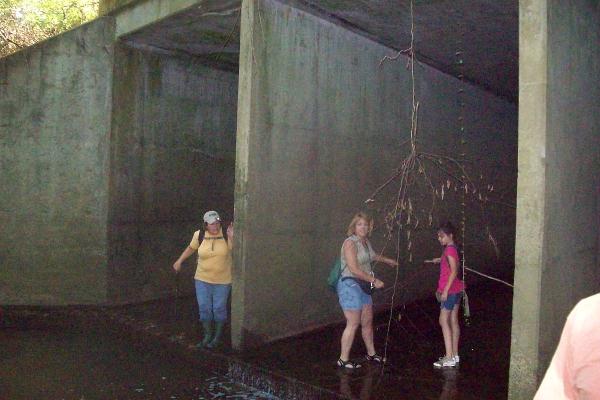
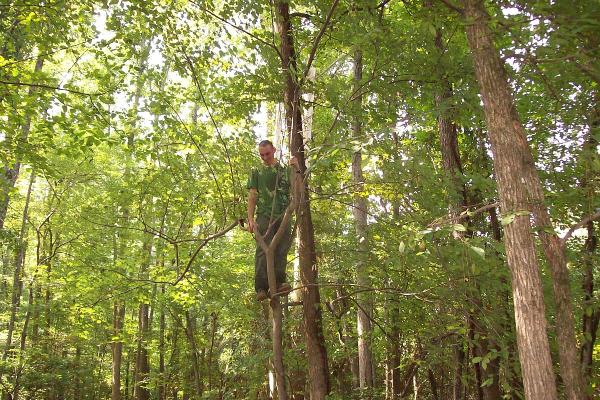
Another superb geocaching adventure today, courtesy of Chris "Vortexecho" Whittemore, over yonder in Durham—a 5-difficulty/5-terrain (the "5" rating being the most difficult) extravaganza called Pandora's Box. It features quite a few stages over a distance of several miles, and each stage presents its own physical challenge and/or brain-numbing puzzle to solve. Went out this morning, bright and early, with a group of twelve, four of whom were armed with "keys" that had been previously found, all of which are necessary to unlock the container that's hidden at the final stage. Without giving too much away, some of the highlights included going into tunnels under the highway; clambering over (and into) a large, abandoned, and singularly distasteful structure; climbing way up into trees; crossing rivers on fallen timber; and sorting out puzzles of various kinds, each of which required participation by the entire group.

Most refreshing was to get together with a number of people, most of whom didn't know each other well (if at all), and having a common objective, which required working as a team to achieve. We had males and females, young (8 to 10) and...uh...mature (50s), and even a Ranger Fox who, perhaps affected by a certain rather toxic stage, wanted to eat people's brains. There was nary a slacker in the bunch—everyone made a valuable contribution to the team—and in the end, after spending the better part of the day on the trail, we were able to claim the final cache. By the time I got home, I looked (and felt) as if I'd been dragged through a sewer, lacerated with briers and barbed wire, and eaten up by mosquitoes whose disregard for DEET bordered on the fanatical...and that shower was more welcome (slightly) than the post-cache martini.

Another first-class job by Vortexecho, who accompanied us on the journey, no doubt to make sure at least most of us got out of the woods with our brains.


Getting ready to rock


Assembled


One of the few easy passages


The Dark Water Passage
Ms. 3 Eagles High: "Hey, did you hear that? The sound of millions of souls, trapped for all eternity, screaming in unutterable torment?"
Little Eaglet: Yeah! Cool!"


"Absolutely NOTHING to see here. Move along."


Old man Rodan wonders...will we all survive?

Monday, August 16, 2010

Gamera, Absolute Guardian of the Incomplete Struggle for the Awakening of the Revenge of Iris


Gamera 3: Revenge of Isis
(Jyashin Irisu Kakusei, 1999)

DVD Description:
Released by ADV, 2003; additional material: interview with SPFX director Shinji Higuchi, press conferences, behind-the-scenes documentary, promo events, trailers, TV spots

Directed by Shusuke Kaneko

Starring: Ai Maeda, Ayako Fujitani, Yukijiro Hotaru, Shinobu Nakayama, Hirotaro Honda, Toru Tezuka, Senri Yamazaki

Rating: 4 out of 5 stars

Yes, Gamera 3 has a crapload of aliases; The Awakening of Iris; The Incomplete Struggle; The Absolute Guardian of the Universe. Revenge of Iris is the official U.S. release title, so for our purposes, we'll go with that.

This film seems to be the fan favorite of the Heisei series, and not without good reason (although I marginally prefer both of the other films in the series, as noted in their respective reviews). It's true that the monster battle scenes boast some of the finest special effects ever to appear in a daikaiju flick, and the sense of actually being in the middle of a giant monster attack may be the most authentic ever. No complaints there, at all. Where the film falls short is in the backstory department, which—very much like Kaneko's GMK—relies on the trappings of pseudo-mythology, and it's all very muddled and superficial. It does become clear that the Gamera of the Heisei films is but one of a number that were created in ancient days by a highly developed but extinct civilization (possibly Atlantis), for a graveyard of "beta version" Gameras is discovered under the sea.

The film begins with a young Ayana Hirasaka (Ai Maeda) remembering Gamera's first battle with Gyaos (from Gamera, Guardian of the Universe), during which Gamera apparently kills her parents and beloved cat, Iris. She and her younger brother go to a small village in the mountains to live with relatives, who keep them only reluctantly. Ayana's hatred of Gamera is at odds with most of those around her, who believe Gamera is the planet's protector. She discovers that the villagers believe in a mythological monster that lives in a cave, and she goes to explore it. In the cave, she finds a giant egg, and in short order, it hatches, releasing a monster that is obviously related to Gyaos but is far more evolved. It bonds with Ayana as if she is its mother, and she names the monster Iris, after her cat, vowing that this monster will destroy Gamera.

A Gyaos appears over Tokyo, pursued by Gamera, who sends it crashing to earth in flames, killing many hapless citizens. Ornithologist Mayumi Nagamine (Shinobu Nakayama) discovers that the Gyaos are rapidly evolving to become bigger, stronger, and more prolific. Soon, Iris reveals itself, now gigantic—and sharing a psychic bond with Ayana. Nagamine enlists the aid of Asagi Kusanagi (Ayako Fujitani), who had shared a bond with Gamera, to break Iris's hold on Ayana, but to no avail. Now, Gamera returns to battle Iris, decimating a large part of Kyoto in the process. During the battle, Ayana experiences Iris's memories, which include killing her own relatives in the village. Beyond that, she also discovers that it was Gyaos, not Gamera, that killed her parents and her cat. She feels completely lost, but Gamera finally prevails over Iris and saves her life. However, as the film ends, a massive horde of Gyaos monsters is seen careening through the sky, heading for Japan.

There is a rather unsatisfactory subplot involving government official Mito Asakura (Senri Yamasaki) and the eccentric Shinya Kurata (Toru Tezuka), who believe that the Gyaos—and Iris, as the ultimate Gyaos monster—are destined to destroy humanity, and they actively work to expedite the process. In the end, Iris destroys both of them, fulfilling their own prophecies of doom.

For what it's worth, the more fantasy-oriented plot works better in context than it does in GMK, Kaneko's next daikaiju entry. Gamera, in the Showa series, became known as a friend to humankind, particularly children; in the Heisei series, Gamera is less a friend than simply an entity whose purposes occasionally coincide with humanity's, though with little or no consideration of the devastation it wreaks. Still, the film's backstory reveals to some degree Gamera's motivation for destroying its enemies.

As the final film of the Heisei Gamera trilogy, The Revenge of Iris offers an unprecedented giant monster spectacle, and ends by setting the stage for what could have been an even larger scale epic, had that ever been Kaneko's plan. As it is, one can only infer that the outcome, whether Gamera might win or lose, would be the ultimate daikaiju cataclysm.

Sunday, August 15, 2010

Caching for Cthulhu

Geocaching is always an adventure, for you never know where it's going to take you — high up into trees, up rocky cliffs, into storm drains, caverns, graveyards, Devils' Tramping Grounds, abandoned towers...even Cthulhu's lair. Yesterday, on a trip to Chapel Hill, I had great fun with a cache called Yuggoth V: The Great Cthulhu, which required obtaining information from certain eldritch books to fill in missing coordinates to the cache. Happiest for me is the fact that one of those books, The Azathoth Cycle, includes my story, "The Pit of Shoggoths" (a.k.a. "S"). By the grace of Yog, I managed to find the cache and even retain my sanity. Oh, I did too, so STFU.

One of the caches I found was hidden at a tiny graveyard in a shadowy corner of an otherwise bright residential neighborhood on the outskirts of Carrboro, a little community of no little character which adjoins Chapel Hill to the west. The graves go as far back as the early 19th century, and buried here are many slaves who later became free men and were among the founding fathers of Carrboro itself. Chalk up another educational and exhilarating experience while out caching.

The trip included some excellent dining at The Spotted Dog in downtown Carrboro and shopping for a few not-so-dark delicacies at A Southern Season and Trader Joe's, which — if there were any mercy — would have stores here in Greensboro.

There are several other caches in the Yuggoth series, courtesy of The Mad Cacher Maingray, which I'm sure would have made Chapel Hill's late, great master of darkness, Karl Edward Wagner, quite proud. I'll be heading back to hunt them as soon as my near-shattered inner reserves have recovered....

Saturday, August 14, 2010

Attack of Legion


Gamera 2: Advent of Legion
(Gamera: Legion Shūrai, 1996)

DVD Description:
Released by ADV (2003); additional material: trailers, TV spots, interviews, short film

Directed by Shusuke Kaneko

Starring Toshiyuki Nagashima, Miki Mizuno, Tamotsu Ishibashi, Mitsuro Fukikoshi, Ayako Fujitani, Yusuke Kawazu, Yukijirô Hotaru

Rating: 4 out of 5 stars

The second of the Heisei Gamera series advances another step in bringing a semblance of stark reality to daikaiju films, despite its vivid element of fantasy and the more complex—and distinctly alien—countenance of Gamera's newest threat. Some comparisons between The Advent of Legion and Godzilla vs. Destroyer, made the previous year, seem inevitable, since both movies feature relatively small insect-like creatures, which swarm the respective title monsters in both films, as well as huge counterparts that engage the title beasts in battle. In the technical department, Legion outshines Destroyer in almost every respect, though it lacks the emotional heart that tends to make the Godzilla film more endearing.

Legion
begins a year after the climax of the previous Gamera film, with Japan still licking its wounds after the assaults by Gyaos. In northern Japan, a meteor crashes to earth; shortly thereafter, strange, insect-like creatures that consume all forms of silicon begin to appear in and around the city of Sapporo. A gigantic, flower-like structure appears in the city, which scientists realize is a type of biological launchpad, meant to scatter the "seeds" of the insect-like creatures, which are named Legion, all over the planet. Before the eruption can occur, Gamera arrives on the scene and destroys the flower. A gigantic "queen" Legion attacks Gamera and wounds it, then flies off to construct a new flower in the city of Sendai. This one erupts, utterly annihilating the city and by all appearances destroying Gamera as well.

The military learns that Legion is attracted by electromagnetic energy and constructs a grid of electrical towers to draw it away from the cities. Asagi Kusanagi, who is psychically linked to Gamera, realizes that Gamera is not dead and uses her mental energy to revive the creature. Gamera returns to engage Legion in battle, and is again seriously wounded. But drawing on a previously unknown power (which is further explored in the following film, The Revenge of Irys), Gamera destroys Legion and then vanishes, leaving humanity to ponder the incredible power that might one day be turned against them.

Advent of Legion benefits largely from the prevalent atmosphere of physical darkness, from its eerie, nighttime opening in the snow-covered mountains of Japan, to the well-staged nighttime attacks of the queen Legion later in the film. The sense of urgency is palpable as the clock counts down to the explosion of the second flower in Sendai, and the destruction of the city is portrayed as a true, horrific tragedy, far more serious in tone than the devastation typically wrought in your average giant monster movie. Once again, director Shusuke Kaneko and special effects director Shinji Higuchi pair up to present the existence of giant monsters to be as believable as any destructive force of nature. With essentially the same team that made Gamera, Guardian of the Universe, Legion is the logical next step, with a strong story and visuals that improve on the already impressive work from the previous film.

Kow Otani again provides an atmospheric score, of essentially the same caliber as the previous film's — more than adequate, yet less distinctive than his best work (Toho's Godzilla - Mothra - King Ghidorah: Giant Monsters All-Out Attack in 2001). Cast-wise, a few key characters from Gamera I, such as Yukijiro Hotaru as former-inspector-now-security-guard Osako and Ayako Fujitani as Asagi Kusanagi return to provide continuity; Miki Mizuno, daughter of popular daikaiju-film actress Kumi Mizuno, also joins to cast in a lead role as scientist Midori Honame.

Although the ending feels rather contrived, Legion rates, overall, as possibly the best of the Heisei Gamera films, with all the dramatic and technical elements coming together to make a consistently superior monster movie. It does suffer the inevitable curse of being the middle film of a trilogy, with much of the fanfare going to the first and final installments — which is not to say the fanfare is not well deserved. Gamera, Guardian of the Universe is a novelty for the giant steps it takes in presenting an all-new, high-quality Gamera film, and Gamera: Revenge of Irys takes the special effects of the series to even greater heights. Dramatically, I don't believe Irys is quite as solid as Legion, suffering some of the very same shortcomings as GMK, which relate to the "mythologized" aspects of the monsters' origins, the one area of storytelling where Kaneko seems to fall a bit short.

Thursday, August 12, 2010

No More Mister Nice Gyaos


Gamera, Guardian of the Universe
(Gamera Daikaijû Kuchu Kessen, 1995)

DVD Description: Released by ADV (2003); additional material: trailers, TV spots, interviews, press conference, behind-the-scenes featurette

Directed by Shusuke Kaneko

Starring: Tsuyoshi Ihara, Akira Onodera, Shinobu Nakayama, Ayako Fujitani, Yukijirô Hotaru, Hatsunori Hasegawa, Hirotarô Honda, Akira Kubo, Kojiro Hongo, Takashi Matsuo

Rating: 4 out of 5 stars

Not that the Showa-era Gyaos was particularly nice, but the Heisei version, which makes its first appearance in this film, is quite the nasty critter indeed. And there's more than one of them.

For the Heisei Gamera series, the big turtle's origin has been completely reworked; no longer merely a prehistoric giant resurrected by a nuclear bomb, Gamera is the genetically engineered product of an advanced but extinct race that lived 10,000 years ago—a counterforce against the Gyaos, which were previously created by the same race to devour environmental pollution but which evolved into a carnivorous, aggressive menace. In the present, three of the pterosaur-like Gyaos appear in the South Pacific and make their way to Japan. In the meantime, a ship carrying plutonium collides with a floating "atoll", which turns out to be...you guessed it...Gamera itself. Attached to Gamera are a number of amulet-like artifacts, and a young girl named Asagi Kusanagi (Ayako Fujitani) discovers that, through one of them, she and Gamera become psychically linked. When Gamera is wounded, she shares its pain; conversely, she is able to provide strength to monster so it will rapidly recover.

The military lures the three Gyaos monsters to the covered stadium in Fukuoka, so that scientists may study them; however, one of the creatures escapes, only to be destroyed by Gamera. The other two, growing rapidly larger, also escape and attack Gamera, who kills a second one with his fire beam. The remaining Gyaos makes a nest amid the wreckage of Tokyo Tower while Gamera retreats to licks its wounds. Eventually, the two monsters come together again; Gamera prevails and returns to the sea till the next time it is needed (the following year, Gamera vs. Legion).

Except for Gamera vs. Barugon—and to some extent the original Giant Monster Gamera—the Showa-era Gamera films catered to a juvenile audience and devolved further into absurdity with each successive film. This newer incarnation, with director Shusuke Kaneko and effects director Shinji Higuchi at the helm, forsakes all previously established history and presents a "guardian" that has little interest in humankind per se, but a fierce loyalty to the planet Earth itself. In its battle with the Gyaos, Gamera racks up some serious collateral damage (and in subsequent films, Gamera's disregard for humanity increases, peaking in the Heisei series' final entry, Gamera III: The Awakening of Irys, where its single-minded focus on defeating its foe results in some graphically depicted death and destruction). In this film, several of the more graphic scenes of carnage exceed most of the depictions of human suffering in the wake of a monster attack up to that time. This element of verisimilitude brings the fantasy closer to the realm of reality, and the staging of the monster attacks gives one the impression that, yeah, if giant monsters existed, they would be like this.

While some scenes featuring Gyaos fail to disguise the fact that they're puppets, most of the monster action succeeds to a remarkable degree in the realism department. Higuchi's effects work excels on virtually every count, particularly in shots of the monsters from low camera angles with realistic scenery in the foreground. The shot of the last remaining Gyaos perched in its "nest" amid the toppled Tokyo Tower, silhouetted by a blazing sunset, is one of the most memorable images in daikaiju history. Despite the advances in CGI over the years, I still prefer good, old-fashioned miniature SPFX, especially when the finished product works as convincingly as so much of this film.

Composer Kow Otani provides a fairly atmospheric musical score, similar in tone to his score for Toho's Godzilla - Mothra - King Ghidorah: All-Out Monster Attack, though considerably less distinctive. Most of the music leans toward the subtle, underscoring the action effectively enough, but rarely coming forth to establish a clear musical identity. In fact, on my first viewing of the film, I found the music altogether underwhelming; when it comes to Gamera, I'm rather partial to the scores by Tadashi Yamauchi (the original Gamera and Gamera vs. Gyaos) and Chuji Kinoshita (Gamera vs. Barugon). I do enjoy Otani's work in GMK, but while I've warmed to his Gamera compositions as used in the films, they're not particularly impressive as stand-alone experiences.

The cast boasts a few standout performers—Shinobu Nakayama as ornithologist Mayumi Nagamine, Ayako Fujitani (daughter of actor Steven Seagall) as the psychic Asagi Kusanagi, and Yukijiro Hotaru as the beleaguered Inspector Otaru, all of whom reprise their roles in subsequent Gamera films. Veteran daikaiju actor Akira Kubo makes a welcome, if brief, appearance as the captain of the Kairyu Maru, the ship that runs aground on the mysterious floating "atoll."

While not perfect, Gamera, Guardian of the Universe succeeds better than most any of the Heisei Godzilla films, largely due to the filmmakers' attention to detail, innovative cinematography, and serious treatment of the monsters. It certainly starts the Heisei Gamera series off on a high note, and happily, the subsequent films maintain—and even surpass—the high standards of quality set by director Kaneko and his team on this landmark monster movie.

Sunday, August 8, 2010

Hootin' and Hollerin'


What a wretched weekend! Friday night, headed up to Martinsville and found a few caches on the way; undertook a late-night walk through my old stomping grounds in the company of some bourbon and ginger ale; on Saturday morning, played guitar and sang with my friend Kim at the Martinsville Farmers' Market (which was nicely written up in the Martinsville Bulletin), followed by a first-rate lunch at El Norteño; placed three geocaches on the newest extension of the Martinsville "Dick & Willie" Rail Trail; went to an excellent wine tasting party at some good friends' place; and spent a fair amount of quality time with Mum and our friend Mary Clifton. Coming back to Greensboro today, found several new caches, including one that led us on a tour of Reidsville's extensive and quite old Greenview Cemetery.

Wait. Did I say "wretched" up yonder? Hmm. I might have goofed....

Tuesday, August 3, 2010

If At First You Don't Succeed, Triphibian


Gappa, the Triphibian Monster
, a.k.a. Monster From a Prehistoric Planet (Daikyojū Gappa, 1967)

DVD Description: Released by Media Blasters/Tokyo Shock (2000); additional material: none

Directed by Haruyasu Noguchi

Starring: Tamio Kawaji, Yôko Yamamoto, Yuji Okada, Kôji Wada, Tatsuya Fuji, Keisuke Inoue

Rating: 3 out of 5 stars

The president of Playmate enterprises, Mr. Funazu (Keisuke Inoue), sends an expedition to Obelisk Island in the South Pacific to gather tropical flora and fauna for Playmate Land, the latest amusement park in Japan. The expedition finds a native village, complete with resident natives; a big old cave; and a monster-sized egg. The egg hatches, and out pops a strange, birdlike reptile, which—according to the natives—is a baby Gappa, their most revered deity. The expedition returns to Japan, taking the creature with them, but mom and pop Gappa emerge from the cave and head to Japan to bring the little one home. Much urban destruction results, but at the end of it all, the more level-headed team members endeavor to return the baby to its parents. The three monsters take to the air and fly back to Obelisk Island to live in peace—perhaps to chow down on more natives, assuming the critters have left a few survivors.

In the mid 1960s, the now-defunct Nikkatsu Productions endeavored to capitalize on the daikaiju craze, which was at its height, with something of a satire. Gappa takes most of the clichéd elements of the standard giant monster film—an exotic South Pacific setting, a greedy exploiter who wants to capitalize on the discovery of the critter, major city destruction, and all-out efforts by the military to stop the monsters—and delivers a package that mostly succeeds, both as send-up and as traditional daikaiju fare. Particularly noteworthy are the special effects by Akira Watanabe, who was a protegé of renowned special effects director Eiji Tsuburaya. While certainly a couple of notches beneath Tsuburaya's, the effects work is a darn sight better than many of the film's contemporaries, including some of Toho's own. The Gappas themselves resemble gigantic gargoyles, with birdlike beaks; leathery bat wings; and scaly, reptilian hide. The effects cinematography is colorful and often atmospheric, particularly during the extensive scenes of city destruction. One noteworthy effects scene is the toppling of the Obelisk natives' stone totem that guards the Gappas' cave entrance, which is 100% convincing.

The cast is an ensemble typical of so many daikaiju offerings from the Showa era; one can just envision a group of Toho regulars, such as Akira Kubo, Kenji Sahara, Tadao Takashima, Kumi Mizuno, and Yu Fujiki, taking on the roles of the expedition members. Not to demean the cast members of the film itself; they're quite adequate in the roles they play, though—as one might imagine—none of the parts in this film were apt to propel the actors to stardom.

The score by Seitaro Omori is adequate, with a handful of distinctive themes that make the soundtrack listenable on its own. However, having grown up with the U.S. version (Monster From a Prehistoric Planet, released by AIP-TV), when I watched the Japanese version, I found it rather jarring to be hit with the bizarre and supremely obnoxious title track ("GAPPA! GAPPA! GAPPA!") rather than the more familiar, traditional orchestral composition of the U.S. release, which is actually pretty good. There's also a song at the end of the Japanese version, happily excised from the U.S. release, which is apt to shake your teeth loose. Interestingly, many scenes during the monsters' attack are devoid of any scoring whatsoever, which actually works on a more serious level, accentuating the scope of the destruction being wrought.

No question, Gappa is a mixed bag; a mediocre story, a bunch of non-memorable people scenes, and some decently rendered monster action. But even its dramatic failings have their amusing moments—which the hellish English dubbing often accentuates; thus, given the fine DVD presentation by Media Blasters/Tokyo Shock (their first tokusatsu release), which includes both the Japanese and U.S. versions in wide-screen, I give Gappa an unabashed recommendation. It's not a great film, or even necessarily good, but it really is a lot of fun, particularly if watching detailed miniature cities receiving a thorough trouncing makes your day worthwhile.

Saturday, July 31, 2010

Hell on Earth


Night caches are among my favorites. You go out into the woods, armed with flashlights, and follow reflectors set up at intervals until you reach the cache's hiding place. These are especially satisfying when the setting is fairly creepy—such as The Devil's Tramping Ground in Chatham County, NC, which was our destination last night. My friend Bridget (Suntigres) and I grabbed a number of hides around Siler City and then drove down to Ye Olde Tramping Ground, which I had visited once before, almost a year ago, to hunt a cache in daylight.

It's a bit more intriguing at night.

The site actually is just off Devil's Tramping Ground Road, a few miles west of U.S. 421. Ground zero is quite unremarkable; just an ordinary-looking clearing in the woods, but which shows the unmistakable signs of much partying—the remnants of a campfire, bits of trash here and there, a number of scorched trees where wisenheimers have left their marks. But the Tramping Ground has a long history, with lots of associated legends. For hundreds of years, nothing has grown in the approximately 40-foot-diameter circle, for reasons that have baffled scientists. If you leave something in the circle, come daylight, it will likely be gone because the devil rises up nightly and clears the ground as he tramps around, making his plans to subvert humankind.

To find the night cache, called Hell on Earth (brainchild of caching maestro Vortexecho), you stand in the middle of the circle and shine your light into the woods, looking for a glowing cyclopean eye staring back at you. Once you find it, you venture into the darkness, searching for more eyes...sometimes pairs of them. At one point, I spotted a large cluster of brilliant green eyes and went to investigate...only to find it was a wolf spider staring back at me. Choruses of Whippoorwills, which I haven't heard in years—and which actually frightened me as a kid—wailed mournfully in the darkness, accentuating the eerie atmosphere, and more than once, Bridget and I heard distant voices in the woods. But no one came after us with torches and pitchforks, and in fairly short order, we had found the cache and scrawled our John Hancocks on the log sheet.

Fortunately, I marked our progress on my GPS so we could backtrack easily because, once we left the rut that passed for a trail, it was difficult to keep our bearings. When we finally arrived back at our starting point, there was no one else around...and no sign of the devil dancing. The excursion was a hoot nonetheless, so our thanks to Vortexecho for a most...enchanting...evening.

Sunday, July 25, 2010

Those Black Hole Guys Are At It Again


Terror of MechaGodzilla
(Mekagojira no Gyakushu, 1975)

DVD Description: Released by Classic Media (2008); additional material: audio commentary, poster gallery, trailers

Directed by Ishiro Honda

Starring Katsuhiko Sasaki, Tomoko Ai, Katsumasa Ichida, Akihiko Hirata, Goro Mutsumi, Toru Ibuki, Shin Roppongi, Tomoe Mari, Masaaki Daimon

Rating: 3.5 out of 5 stars

After a string of juvenile, budget-strapped Godzilla movies in the early 1970s, the big G's 15th film was touted as a "return to greatness," with veteran director Ishiro Honda at the helm and maestro Akira Ifukube providing the score. Without question, the film has more going for it than several of Godzilla's previous outings, but as for a "return to greatness," well...it just kind of ain't. It is, overall, an entertaining if still highly juvenile monster romp.

Those ugly space aliens from the doomed Third Planet of the Black Hole system (from the previous film, Godzilla vs. MechaGodzilla) have returned and created a new mecha-monster with the head of the original robot, which Godzilla had destroyed. However, to avoid the prior pitfalls of a purely robotic construct, they opt to use a living being as its control center, in the person of Katsura Mafune (Tomoko Ai), the daughter of disgraced scientist Shinzo Mafune (Akihiko Hirata), who was cast out of the scientific community because of his radical beliefs about mind control and the existence of a dinosaur called Titanosaurus. Mafune is happy to help the aliens because they have saved Katsura's life on more than one occasion—in effect, turning her into a cyborg. Katsura herself is ambivalent until she finds herself attracted to Professor Ichinose (Katsuhiko Sasaki), who is leading the search for Titanosaurus. The Black Hole guys unleash MechaGodzilla and Titanosaurus on Tokyo, but Godzilla appears to tangle with them, and Katsura is electrocuted. Once again, the Black Hole guys restore her, but now she is more mechanical than human. Ichinose has faith in her humanity, however, and in the end, she kills herself, allowing Godzilla to destroy MechaGodzilla II. Dr. Mafune is killed as Ichinose and Interpol destroy the aliens' base. Titanosaurus falls into the sea, and Godzilla returns to Monster Island, or wherever he happens to reside at this go-round.

The people scenes in Terror of MechaGodzilla to some extent mark a return to the familiar Honda style of direction, with a far grimmer atmosphere than any of the films since Godzilla vs. Hedorah. Akira Ifukube's score adds an element of the eerie in numerous scenes, and his powerful MechaGodzilla and Godzilla themes, the latter of which is based on motifs from the original Godzilla, inject a note of seriousness completely absent from other entries in the late Showa-era series. While the scenario is completely outlandish, an undeniable air of tragedy hovers over Katsura, who is at once villain and unfortunate victim of the story.

Sadly, a disproportionate number of the monster scenes fall back on the goofball antics of the previous films with effects directed by Teruyoshi Nakano. Time after time, Godzilla appears as nothing more than an empty suit, getting tossed and bounced around like a helium balloon, to such embarrassing effect that even Ifukube's majestic score can't salvage the scenes. In fact, they're prevalent enough to spoil the entire picture, leaving such a bad taste that it's hard to appreciate many of the finer scenes, such as Godzilla staggering against the powerful wind whipped up by Titanosaurus's tail; or MechaGodzilla II and Titanosaurus marching side by side, razing everything in their path; or MechaGodzilla II unleashing an awesome barrage of missiles that blow a city block literally sky-high. The laughable scenes are so incompatible with the tone of the movie that, even having some understanding of how Japanese audience's expectations differ from their western counterparts, I still find the reasoning of the moviemakers utterly inexplicable. A touch of comic relief is one thing; total incongruity is another.

It doesn't help that the Godzilla suit, while a little fiercer looking than its previous incarnations in Godzilla vs. Megalon and Godzilla vs. MechaGodzilla, still resembles a Muppet more than the King of the Monsters, with big, balloon-like dorsal fins and oversized, rounded feet. Titanosaurus's design is interesting enough, with fish-like fins that give it the distinct appearance of a sea animal. MechaGodzilla II, similar in appearance to the original, with a few modifications, certainly makes for an impressive mecha-monster, and in most cases, its movements are convincingly mechanical.

The Classic Media DVD includes the original, uncut Japanese version and the extended U.S. version originally released by Henry Saperstein directly to television. The Bob Conn Enterprises theatrical version, which saw only limited release in 1978, was originally known as Terror of Godzilla and was significantly edited to excise scenes of violence (and the infamous scene of Katsura's naked, obviously artificial breasts)—so much so that the ending makes no sense whatsoever. Interestingly, Saperstein's television version retained these scenes, which runs counter to expectations from that day and age, when it was typically television releases that were so heavily edited.

The Classic Media DVD release, of course, is a big winner. It does the movie justice and then some.

Saturday, July 24, 2010

Barugon: A Rare Gem


Gamera vs. Barugon
(Gamera Tai Barugon, 1966)

DVD Description: Released by Shout! Factory, (2010); additional material: publicity gallery, still gallery, trailer, commentary

Directed by Shigeo Tanaka

Starring Kojiro Hongo, Kyôko Enami, Yuzo Hayakawa, Takuya Fujioka, Kôji Fujiyama, Akira Natsuki, Yoshiro Kitahara, Ichirô Sugai

Rating: 3.5 out of 5 stars

The Shout! Factory releases of the Gamera series are easily among the best—if not the best—of any daikaiju films in the United States. They're reasonably priced, present beautiful, widescreen prints of the original Japanese versions of the movies, and offer several extras—including booklets in the package with additional info on the films, in this case a retrospective of his involvement with Gamera vs. Barugon by star Kojiro Hongo. Furthermore, the upcoming Gamera releases are double features—Gamera vs. Gyaos/Gamera vs. Viras and Gamera vs. Guiron/Gamera vs. Jiger. This release of Gamera vs. Barugon also offers an insightful commentary by August Ragone and Jason Varney.

Originally presented as a television release, titled War of the Monsters, by AIP-TV in 1967, Gamera vs. Barugon is arguably the best of the Showa-era (1965-1970) Gamera films. With a far more mature plot than the rest of the series, superior special effects, and a fine musical score by Chuji Kinoshita, the movie offers a lot more for daikaiju fans than fodder for MST3K, which certainly can't be said of most of the Gamera series.

The film opens with a flashback to the original Gamera and his voyage into space via Plan Z. But as the story proper begins, the rocket crashes into a meteor, and Gamera returns to Earth, initially attacking Kurobe Dam in Japan to satiate his craving for energy. Next, we meet a rather shady group of adventurers, who are plotting an expedition to New Guinea, to recover a giant opal that their leader, Ichiro Hirata (Akira Natsuki), found during World War II and hid in a cave. Three of them—Hirata's younger brother Keisuke (Kojiro Hongo), Kawajiri (Yuzo Hayakawa), and Onodera (Kôji Fujiyama)—make the journey, landing in a small village of natives, where they also meet a Japanese doctor named Matushita (Ichiro Sugai) and his assistant, Karen (Kyoko Enami), who implore them to stay away from the cave. Ignoring the warnings, the three find the cave as well as the opal they seek. However, a scorpion kills Kawajiri, and Onodera attempts to kill Keisuke by blowing up the cave. However, Keisuke escapes with his life and is brought to the village, where Karen nurses him back to health. Here, he learns that the opal is not a gem but the egg of the monster Barugon, which will bring great tribulation to Japan.

Keisuke and Karen travel to Japan to find Onodera, who has arrived in Kobe. However, the egg hatches, and the monster Barugon begins a rampage through the city. Its tongue emits a subzero vapor that freezes anything it touches, and it can unleash a lethal "rainbow ray" from its back that disintegrates matter. Gamera, attracted by Barugon's ray, attacks the monster, but Barugon is able to freeze Gamera solid. Karen tells the military that Barugon, being a land monster, is vulnerable to water and can be lured into Lake Biwa using a huge diamond, which will attract it. The effort is almost successful, but Onodera, infuriated by the loss of the "opal," steals the diamond—only to be killed by Barugon as he tries to escape.

Now, the military endeavors to turn Barugon's rainbow ray back on it via a giant parabolic mirror, but the effort only wounds the creature. However, Gamera has now thawed out and once again attacks the monster, finally dragging it into Lake Biwa, destroying it. The big turtle flies away to await a role in his next adventure, and Keisuke ponders how to make amends for his part in so much death and destruction.

Although ostensibly the star of the film, Gamera is actually a secondary character, spending most of the movie in frozen hibernation. The greater part of the plot is about the massive undertaking to defeat Barugon, which, sadly for the Japanese, just isn't in the cards. In the end, it is up to Gamera to reappear and drag Barugon into the water. Gamera's long absence isn't much of a failing, however; much of Barugon's rampage is visually exciting, the attempts to counter him rather novel. Unfortunately, Barugon itself is not that impressive-looking a creature. While its design is suitably lizard-like, the man-in-suit technique by nature is not conducive to rendering a creature that walks on all fours. At least on occasion, the cinematography overcomes the problem by showing the monster behind rows of buildings or from angles that de-emphasize the body of the actor inside the suit.

Unlike the rest of the Showa Gamera series, including the original 1965 film, little kids play no part in the story, which is really how it ought to be anyway. The protagonist is among the most flawed in daikaiju movie history, and his part in the awry scheme to retrieve his brother's opal results in his suffering visible, almost unbearable guilt. Onodera, as a calculating, greedy, and thoroughly cold-hearted bastard, is a far darker character than most of the cartoon-like antagonists from the majority of that era's daikaiju films. Alas, despite my personal preference for it, the film's serious tone didn't go over quite so well with Japanese audiences—so many of whom were youngsters back in the day—and thus the subsequent Gamera films became more and more juvenile, deservedly earning the ridicule they so often received from western audiences.

I can't say enough good about the Shout! Factory DVD of Gamera vs. Barugon. It's a real treat, and showcases one of the most deserving giant monster movies of the 1960s. Go grab it. Go on.

Thursday, July 22, 2010

Endless Shadows at Elder Signs Press....

A blog about a blog....

Endless Shadows....
"I’ve always loved Dark Shadows, the horror/fantasy/SF/gothic/romance ABC-TV soap opera that ran from 1966 to 1971—not to mention the pair of movies the series spawned (House of Dark Shadows [1970] and Night of Dark Shadows [1972]), as well as the 1991 NBC-TV revival series. Now, a new cinematic adaptation of the franchise is in the planning stages, set to star Johnny Depp as the infamous vampire, Barnabas Collins (though whether the project will actually see the light of day is anyone’s guess). In its day, the original series drew fans of all ages; many of the show’s actors achieved something akin to superstar status; and the property became a merchandiser’s wet dream, generating everything from trading cards to board games to a series of paperback novels...."

Read the whole article at Elder Signs Press: Endless Shadows

Monday, July 19, 2010

Japan's Urban Renewal Program


Godzilla 1985
(Gojira, 1984)

DVD release: none currently; available on VHS only (OOP)

Directed by Koji Hashimoto

Starring Ken Tanaka, Yasuko Sawaguchi, Yosuke Natsuki, Keiju Kobayashi, Shin Takuma, Eitarô Ozawa, Taketoshi Naitô, Hiroshi Koizumi

Rating: 3.5 out of 5 stars

So far, I've reviewed only daikaiju films that are available domestically on DVD; however, there are a couple in the Godzilla series that, due to complicated licensing situations, have never been released in the U.S. on DVD. Godzilla 1985 (a.k.a. Godzilla and Return of Godzilla) is the most significant of them, in that it launched the Heisei Godzilla series (the films from 1984 to 1995) and was a direct sequel to the original Godzilla (1954), ignoring all the prior films and creating an entirely new continuity. It's ironic that even the American version is not available on DVD since, during the mid-to-late 1980s, it was so ubiquitous on VHS (and even Pioneer laser disc) that you never thought you'd see the end of thing. But now, as far as I know, no one, including Toho, has any plans for a U.S. DVD release. Still, bootlegs of both releases are not uncommon, and though it's out of print, VHS copies of the U.S. version may still be found.

After the near-collapse of the Japanese film industry in the 1970s, occasional rumors of a new Godzilla film would surface, but it wasn't until 1984 that Toho produced the first new Godzilla film in almost a decade. Originally titled simply Godzilla (though subsequently most often known as Return of Godzilla), the film was made with a budget far larger than any of the previous entries in the series, and featured a much-hyped twenty-foot-tall animatronic Godzilla—if only in a handful of scenes. For the better part of the film, Godzilla was still played by a man in a suit—Kenpachiro Satsuma, who had played Hedorah and Gigan in the Showa series—which was a very good thing because the "cybot" Godzilla appeared artificial and moved very awkwardly. For the special effects, Toho relied on the talents of Teruyoshi Nakano, who had been an assistant special effects director under Eiji Tsuburaya and chief special effects director from Godzilla vs. Hedorah to the end of the Showa series.

The story is simple enough: a volcanic eruption gives rise to a new Godzilla (though the American version insinuates that it might be the original, since "no body was ever found"), who sinks a few ships and a submarine. This monster is bigger than the original—eighty meters, rather than fifty—and has a distinct taste for nuclear reactors, for it homes in on Japan to attack them and consume the radioactivity. As Godzilla makes landfall and begins to trash Tokyo, a scientist named Hayashida (Yosuke Natsuki, who starred in Ghidrah, the Three-Headed Monster and Dagora, the Space Monster) observes that Godzilla responds to the calls of birds. Therefore, he devises a contraption that, via sonic waves, lures Godzilla to Mt. Mihara on Oshima Island (the same place where Gamera succumbed to Plan Z in Daiei's Gamera in 1965), where the monster topples into the volcano, which by the use of explosives has been made to erupt.

Unlike the later movies of the Showa era, Return of Godzilla is played straight, made much in the style of the ubiquitous disaster movies of the period—which really was a wise move. Admittedly, the film tends to plod quite a bit in the middle, with a significant amount of debate about whether Japan should allow nuclear weapons to be used against Godzilla. Japan does not, at least willingly, but an accident renders the argument moot. Well, it's an accident in the Japanese version; in the American re-edit, the Russians are shown to launch a nuclear missile on Tokyo on purpose, which in effect makes them no less the villains than Godzilla.

As a matter of fact, the American version, released by New World Pictures in 1985, under the title Godzilla 1985, contains more alterations than just about any other Godzilla movie since the original. In an interesting move, Raymond Burr, as reporter Steven Martin, reprises his original role, and while he plays his relatively few scenes completely straight, the rest of the American cast members are nothing more than buffoons, and do more than their share to reduce to U.S. version to pure camp. In addition, numerous scenes are rearranged or abridged, few for any discernible reason, and Reijiro Koroku's musical score suffers from merciless editing and rearranging. Regardless, Godzilla 1985 does offer a handful of improvements in the pacing department, and a few of the edits tighten a scene or two that in the original seemed clumsy, most notably during the appearance of the giant "sea louse," which precedes Godzilla's appearance.

It really is a shame that Return of Godzilla/Godzilla 1985 has yet to see a legitimate DVD release on this side of the Pacific. Despite its many problems, in some ways it's a respectable follow-up to the original Godzilla, and is generally entertaining in its own right.

Friday, July 16, 2010

A Major Monster Meldown...


Godzilla vs. Destroyah (Gojira Tai Desutoroya)
(1995)

DVD Description:
Released by Sony/Tristar; additional material: trailers

Directed by Kazuki Omori

Starring Takurô Tatsumi, Yôko Ishino, Yasufumi Hayashi, Megumi Odaka, Sayaka Osawa, Saburo Shinoda, Akira Nakao, Masahiro Takashima, Momoko Kôchi, Shelley Sweeney

Rating: 3.5 out of 5 stars

I've always gotten a chuckle out of the name "Destroyah," since it's simply a too-literal translation of the Japanese Katakana characters that represent the English word "Destroyer." Toho tends to trademark its monster names using whatever odd spellings its resident linguists come up with, so "Destroyah" actually is Toho's official name for Godzilla's ultimate foe of the Heisei series. But because I find it all a silly thing, you will never see me refer to the monster as anything but "Destroyer"—which is, after all, what the damn name means. (Similarly, you will never see me use the spelling "Anguirus" for Godzilla's first foe and later ally; I'll accept Angilas or even Angurus, which are both valid pronunciations of the Katakana characters, but official or no, that "gui" syllable simply doesn't exist in the original name. Call me stubborn. If we relied on Toho for official spellings, we'd be flying "Japan Air Lens" across the water.)

But Angilas isn't in this movie, so enough of that. Godzilla vs. Destroyer is the Heisei Godzilla's swan song, and Toho went a few extra miles to make the movie visually and dramatically superior to its previous offerings. Some of those efforts paid off; some of them didn't. On the good side, we have Godzilla Junior, no longer a bouncy, cute little thing but a full-fledged Gojirasaurus that very much resembles its larger and fiercer dad. We have a cameo by Momoko Kochi, reprising her role as Emiko Yamane from the original Godzilla, as well as a couple of younger members of the Yamane family who show a firm grasp of their family history and its relationship to Godzilla itself. Akira Ifukube contributes one of his all-time best scores, ranging from the most powerful to the most reflective. On the bad side, we have...Destroyer.

Destroyer is the result of a compound called micro-oxygen, which has destructive properties similar to the oxygen destroyer invented by Dr. Serizawa in the original film. A mutated prehistoric organism, Destroyer undergoes several metamorphoses, growing larger with each successive stage. In addition, similar to Hedorah, the Smog Monster, lots of little Destroyers can combine to form a single giant creature. Unfortunately, in its final stage, the creature is so big and ungainly that it appears more ludicrous than impressive. When a horde of small Destroyers make a massive assault on Tokyo, the insect-like creatures are no more animated than a bunch of Bandai toys, ruining what might have otherwise been a memorable scene. (In 1996, Daiei put Toho to shame with a similar sequence in Gamera vs. Legion, and Toho finally redeemed itself with the impressive "swarm" scene in 2000's Godzilla vs. Megaguirus.)

The whole point of Godzilla vs. Destroyer, though, was to bring audiences to view Godzilla's actual death. In the opening scene, an enraged Godzilla appears in Hong Kong, its body glowing a fiery red, its nuclear-powered ray more destructive than ever. We learn that Godzilla's atomic heart is overloaded with radioactivity and is on the verge of a meltdown—so devastating that it has the potential to destroy all of Japan, if not the entire world. Every scientific effort is made to cool Godzilla's overheating internal furnace, but all they succeed in doing is buying some time while it is engaged in battle with Destroyer. Godzilla Junior joins in the battle, but Destroyer mortally wounds the young one. At last, Godzilla's super-powerful heat rays and the military's supercooled freeze beams combine to eliminate Destroyer once and for all. But now, the meltdown begins, and Godzilla's body withers away to nothing but ash. An immense cloud of radioactivity spreads over Tokyo, turning it into a ghost city. But then the radiation levels suddenly begin to drop—absorbed by the revived Godzilla Junior, whose body transforms into a new, mature Godzilla.

Whatever its failings, Destroyer succeeds in conveying a sense of hopelessness as it builds to its climax. Nothing humankind does can stop the inevitable course of unnatural nature as Godzilla begins its meltdown. As the monster's body begins to dissolve, Akira Ifukube's emotionally charged requiem heralds the end of something significant—to put it in the words of the final narration of Rodan, the Flying Monster, "as if something human were dying." Though there's no articulation of the actual human toll resulting from the massive spread of radioactivity, the final scene of the devastated, mist-shrouded cityscape paints an eerie portrait of ultimate lifelessness. Then...as the radiation levels drop, the camera advances through the mist, where something in the distance appears to be moving. Finally, the camera zooms in on the new Godzilla, leaving no doubt that, despite the demise of one, the legacy will continue.

Destroyer did signal the end of the Heisei series, which had become rather tired, its plots and characters showing little imagination on the part of the creators. When the "Millennium" films rejuvenated the series, beginning with Godzilla 2000 nearly five years later, a whole new style and rewriting of Godzilla history would be their hallmark. At least the final Heisei film showed respect for the property and offered closure to the continuity that began with Return of Godzilla (Godzilla 1985). It's a film fraught with problems, but these are largely outweighed by its positive aspects, so in the end, Godzilla vs. Destroyer makes a respectable closing for an important chapter in the history of the cinema's most powerful monster.

Tuesday, July 13, 2010

Godzilla Clone From Outer Space


Godzilla vs. Space Godzilla (Gojira Tai Supesu Gojira)
(1994)

DVD Description:
Released by Sony/Tristar; additional material: trailers

Directed by Kensho Yamashita

Starring Megumi Odaka, Jun Hashizume, Zenkichi Yoneyama, Akira Emoto, Towako Yoshikawa, Yôsuke Saitô, Kenji Sahara, Akira Nakao, Kôichi Ueda

Rating:

Over the years, Toho has presented several "Godzilla vs. Godzilla" scenarios, ranging from the various MechaGodzilla variants to Biollante (a "one-third Godzilla" amalgamation) and even to the essence-stealing Orga in Godzilla 2000. Space Godzilla is the most overt of the Godzilla clones, having been created by G-cells carried into space either by Biollante or Mothra. The monster's design is impressive enough, with a distinctly malevolent countenance, clearly based on Godzilla's features. Its body is partially composed of crystal, which alters its size and shape and provides a means of flight, both in outer space and in the atmosphere.

Godzilla himself appears stockier than in the previous Heisei films, so much so that the suit looks ungainly, with a head too small in proportion to the rest of the body. I'm not at all fond of this design, though it's still superior to some of Godzilla's more muppet-like features in the Showa-era films.

Space Godzilla follows directly on the heels of Godzilla vs. MechaGodzilla and features a similarly utilized mecha-monster: an updated design of Mogera, which originally appeared as an instrument of the invading aliens in 1957's The Mysterians. Unfortunately, this version of Mogera is inferior to the 1993 MechaGodzilla (which is itself inferior to both the earlier and later MechaGodzilla variants) and even the Mysterians' Mogera. It is especially awkward-looking in flying mode, and it doesn't help that the outer space effects in general look far cheesier than those in the Toho films of the 1960s.

The story is a mixed bag, with a few superior dramatic elements offset by others that are ill-conceived and/or executed. An unknown monster appears in outer space, destroys a space station, and lands somewhere on Earth. In the meantime, a G-Force contingent, including psychic Miki Saegusa (Megumi Odaka) goes to Basu Island, where the little Godzillasaurus birthed in the previous film has taken up residence. They intend to experiment with telepathy (Project T) and its influence on the monster, hoping they can use it as a weapon against Godzilla. However, G-Force member Akira Yuki has a special grudge against Godzilla, who killed his best friend, Goro Gondo (in Godzilla vs. Biollante) and hopes to kill Godzilla with a special blood coagulant he has developed.

Lo and behold, Godzilla arrives on Basu Island, and the telepathy experiment shows promise, as Miki is able to partially control Godzilla. However—bad timing!—Space Godzilla shows up here, throwing a monkey wrench into the works; it fusses with Godzilla and Little Godzilla for a bit and finally entraps the young 'un in a crystal prison. It then retreats, and Godzilla follows it away.

Goodness me, now we learn that one of the G-Force scientists, Susumu Okubo (Yosuke Saito), is actually a member of the Japanese mafia and wants to use Project T to gain control of Godzilla for his organization. He kidnaps Miki and is about to use her for the Yakuzas' nefarious purpose when Space Godzilla arrives and wreaks havoc, killing Okubo in the process. Now Godzilla comes around, has it out with his monstrous clone, and with some assistance from Mogera, eventually prevails, allowing Little Godzilla to be set free. All are happy. Except Space Godzilla.

Dramatically, the whole Yakuza angle seems out of place; it adds nothing substantial to the story and contributes to what is oftentimes a plodding pace. Megumi Odaka, as psychic Miki Saegusa, who had virtually nothing to do in the past couple of films, takes on a more substantial role in this film, but too much of it involves her fussing about how messing with Godzilla via telepathy is a bad idea. Rogue G-Force Major Yuki is the most interesting character in the film, as his motivations are certainly the clearest, and his curmudgeonly demeanor can be endearing (if occasionally irritating). As in most of the Heisei series, several of the prominent cast members really do little more than take up space, and this is particularly true in Space Godzilla.

While Little Godzilla isn't quite as pitiful in design as Minya, it's pretty close. As a hatchling in the previous film, the baby Godzilla looked right respectable, even convincing. Little Godzilla is a bug-eyed, terminally cute dinosaur obviously meant to appeal to the kids in the audience. Its only really effective scene is when it is "abducted" by Space Godzilla, which succeeds in at least some measure of pathos, though you know that, before it's all over with, Godzilla's going to come to the rescue.

Takayuki Hattori turns in a reasonably interesting musical score, with a particular theme that is reminiscent of John Barry at his best. The action themes and incidental music are built on heavy, grim motifs that complement the drama as well as one could expect. The inevitable usage of Ifukube's Godzilla theme could actually be discarded, since it's at odds with the tone of Hattori's score, and the movie's original music stands on its own well enough.

One gets the feeling that Space Godzilla was Toho's attempt to propel the series in a slightly different direction, with more emphasis on character; yet it still doesn't work very well. The standard military characters are by now wearing thin, and "surprises," such as Okubo turning out to be Yakuza, offer nothing substantive. Combined with an obviously lower-than-usual special effects budget, the dramatic failings ultimately render Space Godzilla a mediocre entry in the series.